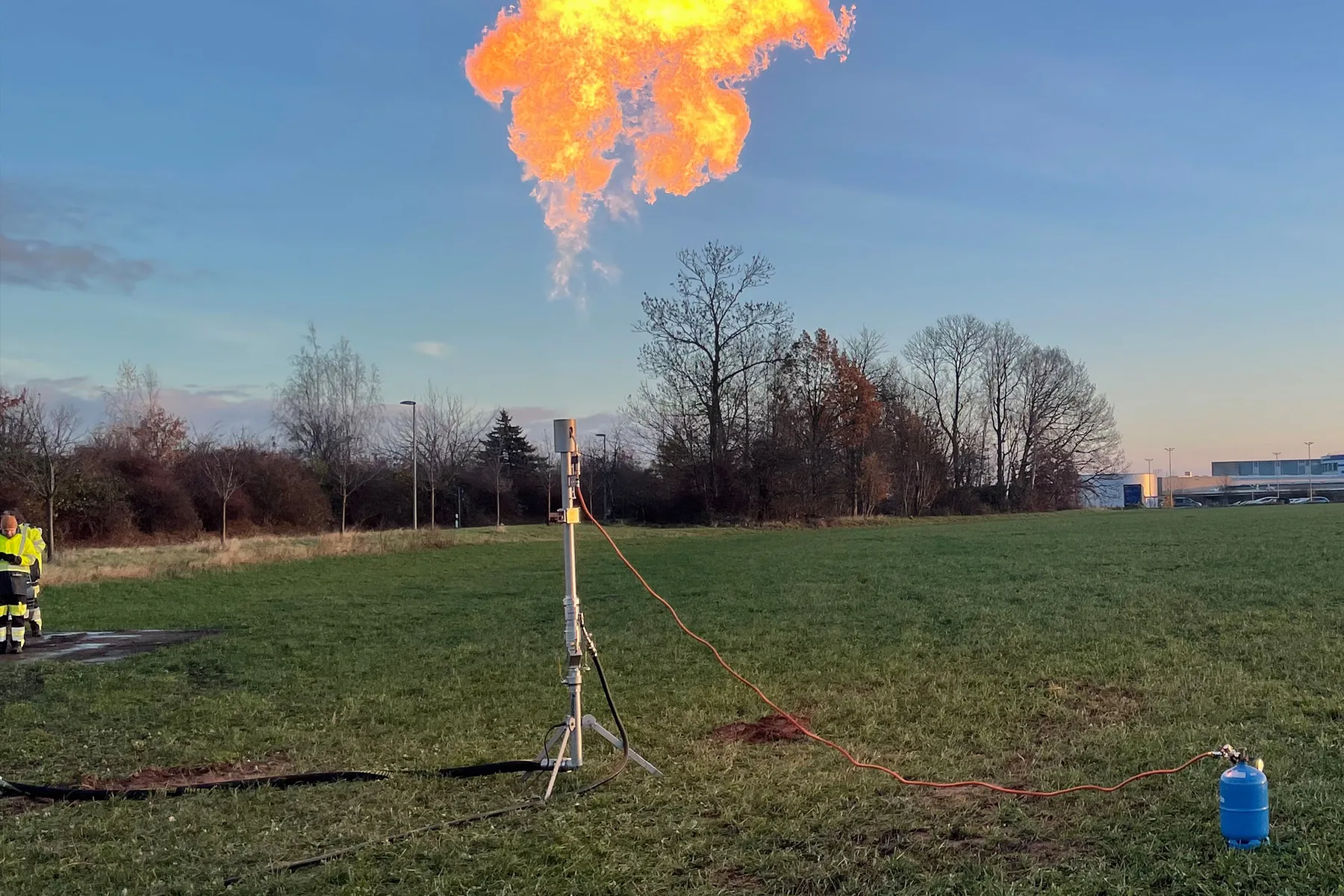
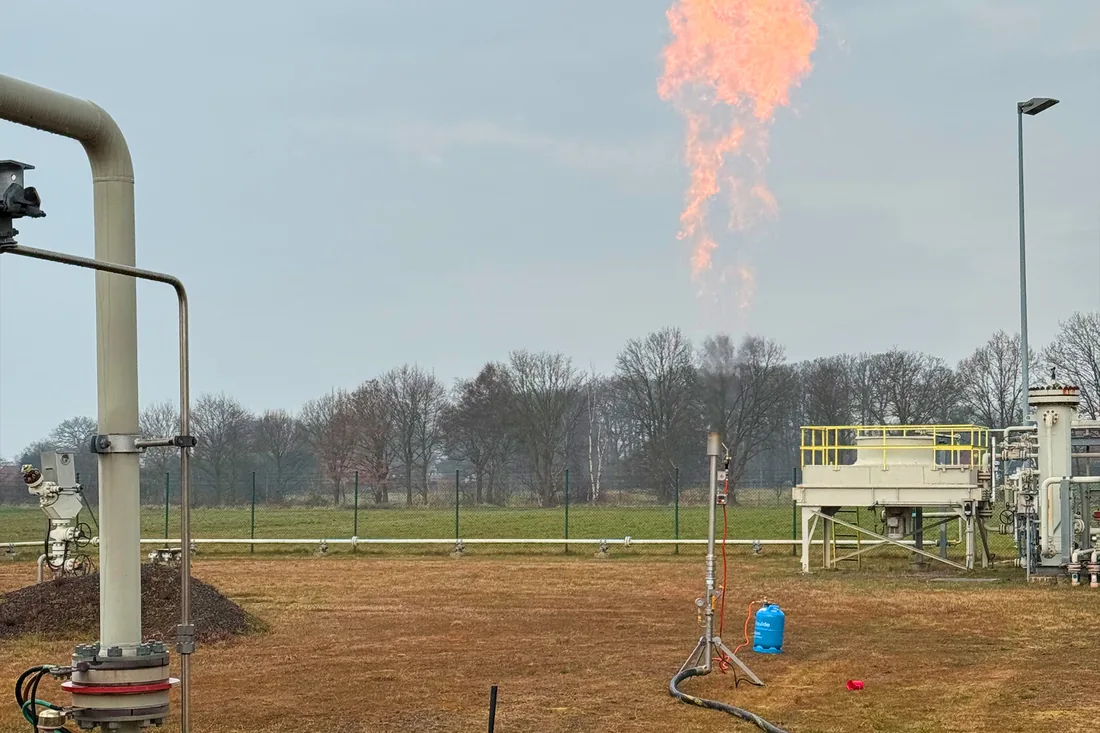
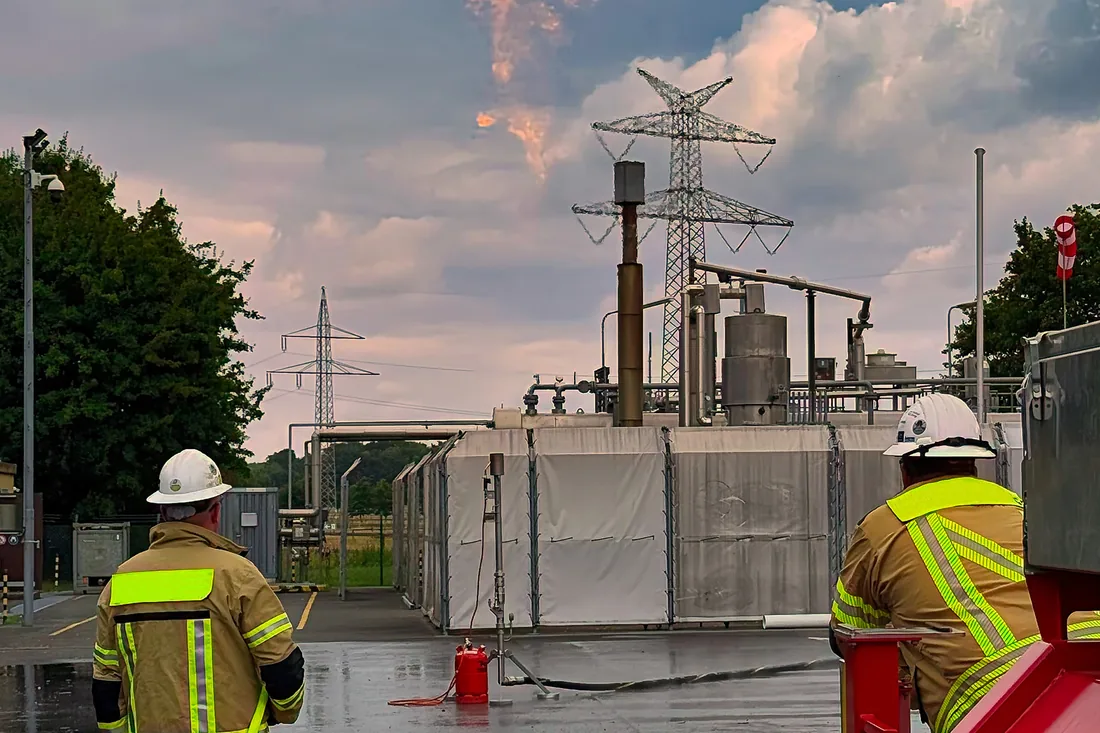
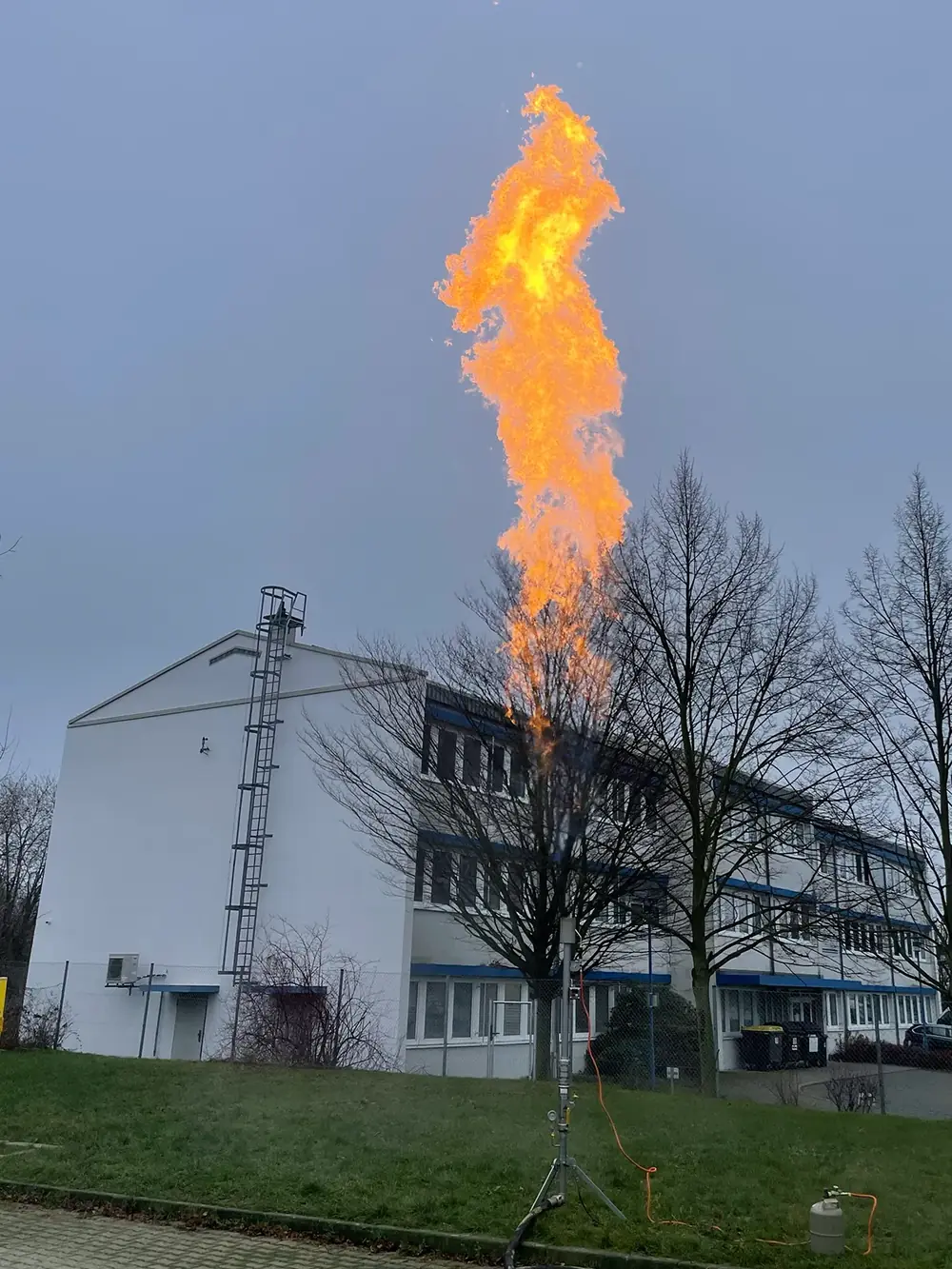
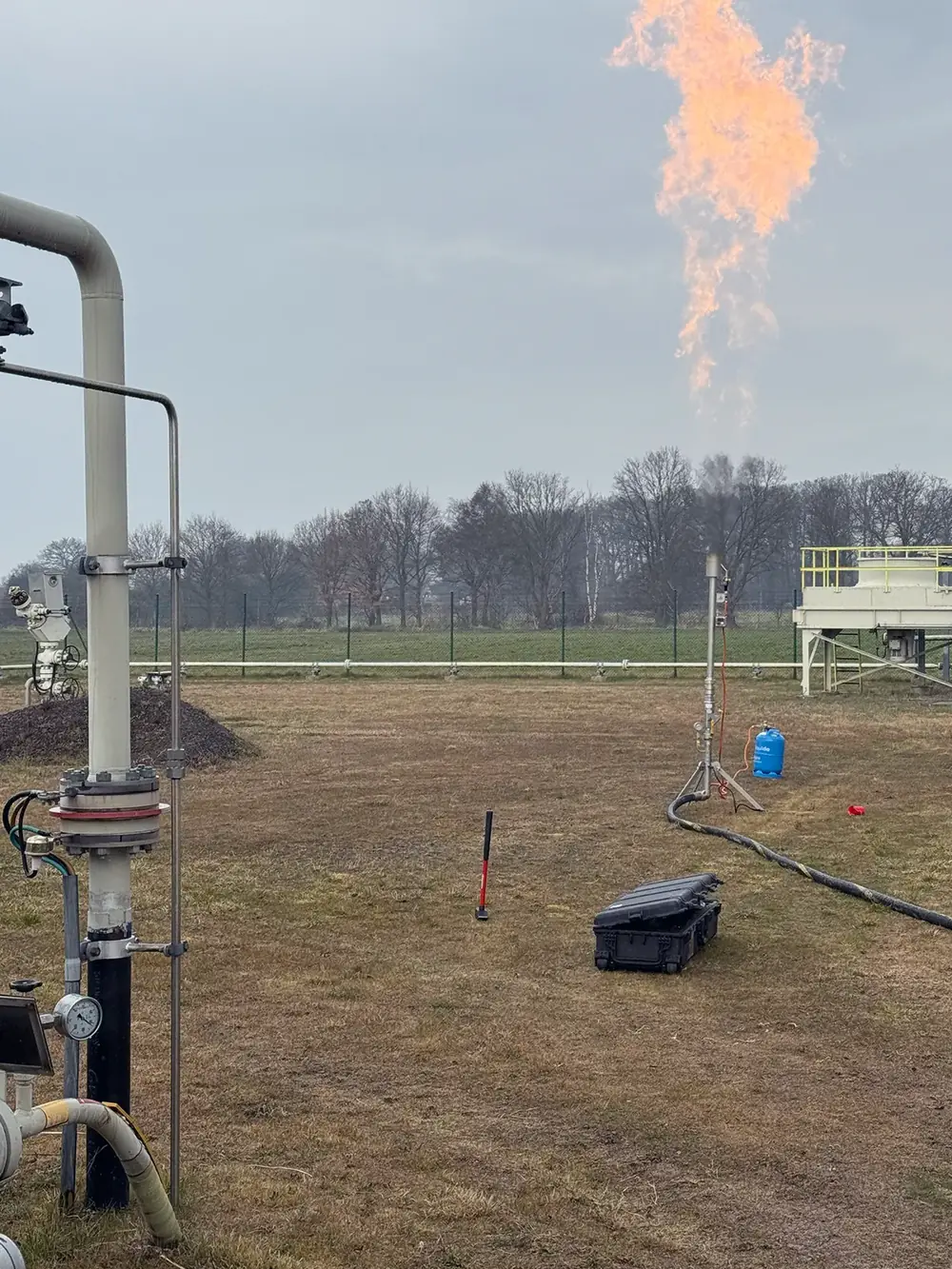
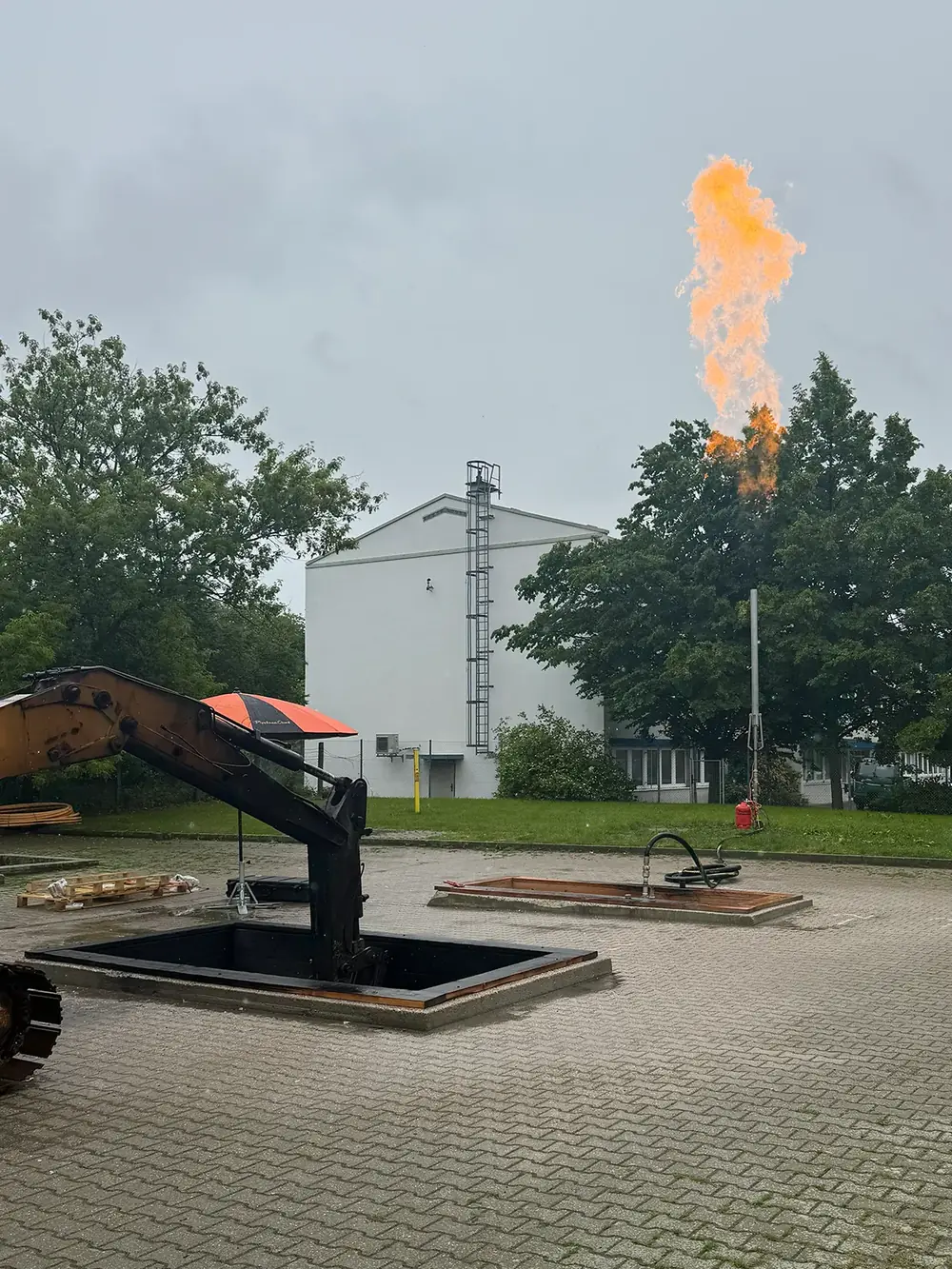
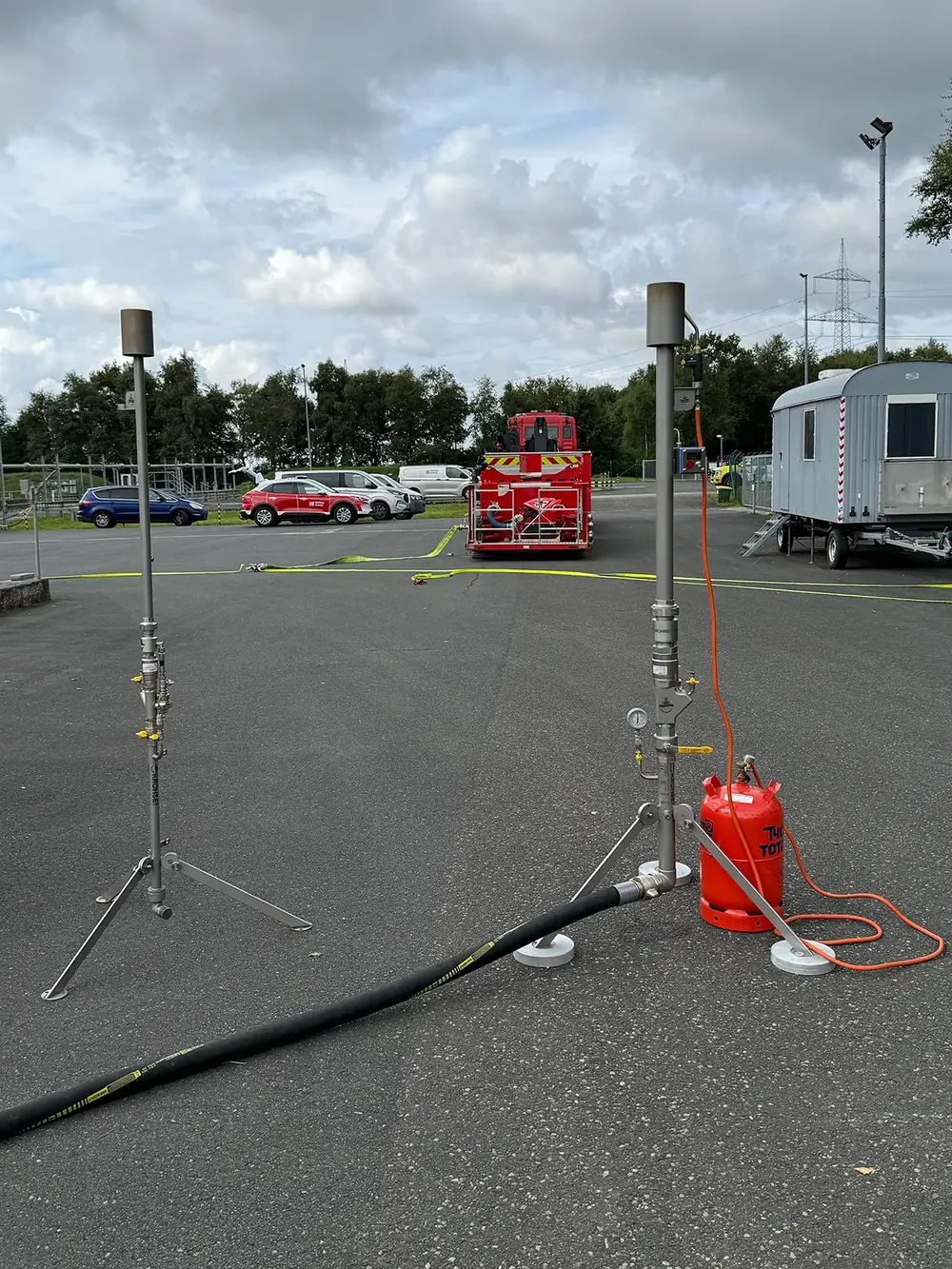
Mobile gas flares DN 25 & DN 50Flare residual gas safely and prove it
Rugged stainless-steel flaring units for natural gas, biogas, propane, town gas and hydrogen — the DN 50 up to 16 bar. DBI-tested with over 99 % burnout under Article 17 of the EU Methane Regulation. Buy, hire or let us do the flaring.
EU Methane Regulation2024/1787 — auditable documentation
Stainless 1.4301low-maintenance, built for outdoors
CE-compliantEN 1762:2018, ISO 3821
01Why now
EU Methane Regulation 2024/1787
Does your gas flare meet Article 17?
Article 17 of the regulation sets two requirements for gas flares. For all units — including existing ones — the deadline expired on 5 February 2026. The DN 25 and DN 50 gas flares meet both, verified by DBI Freiberg.
01
At least 99 % destruction and removal efficiency
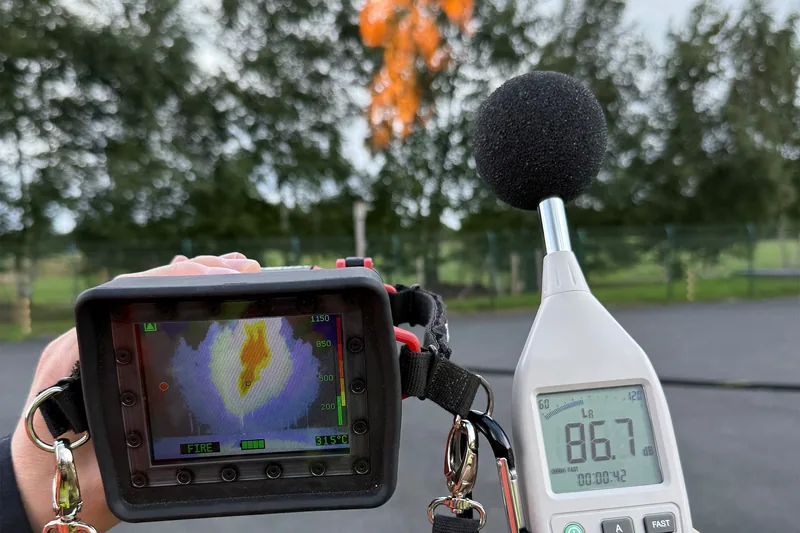
The regulation permits no more than 1 % residual methane in the exhaust. DBI — Gastechnologisches Institut gGmbH Freiberg, an independent group of companies within DVGW — tested both sizes to EU Methane Regulation 2024/1787, VDI 2105 (10/22) and TA-Luft (08/2021). Both units carry the DBI test mark.
02
Auto-igniter or continuous pilot burner
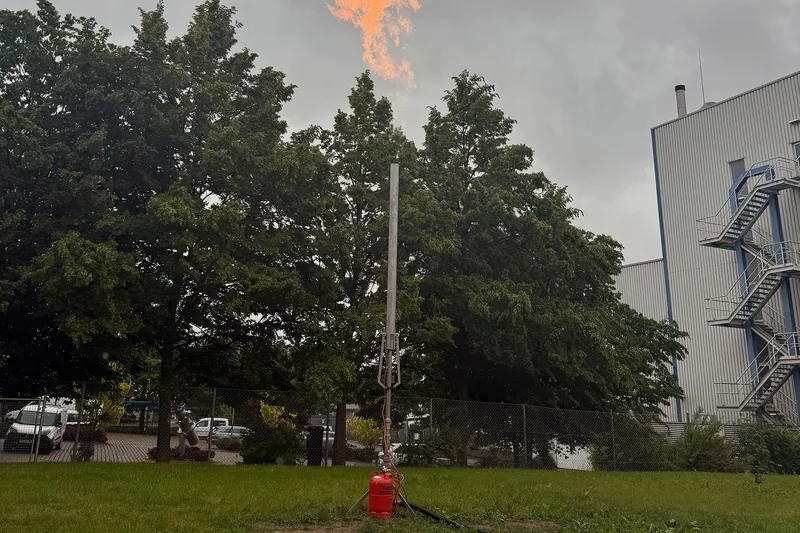
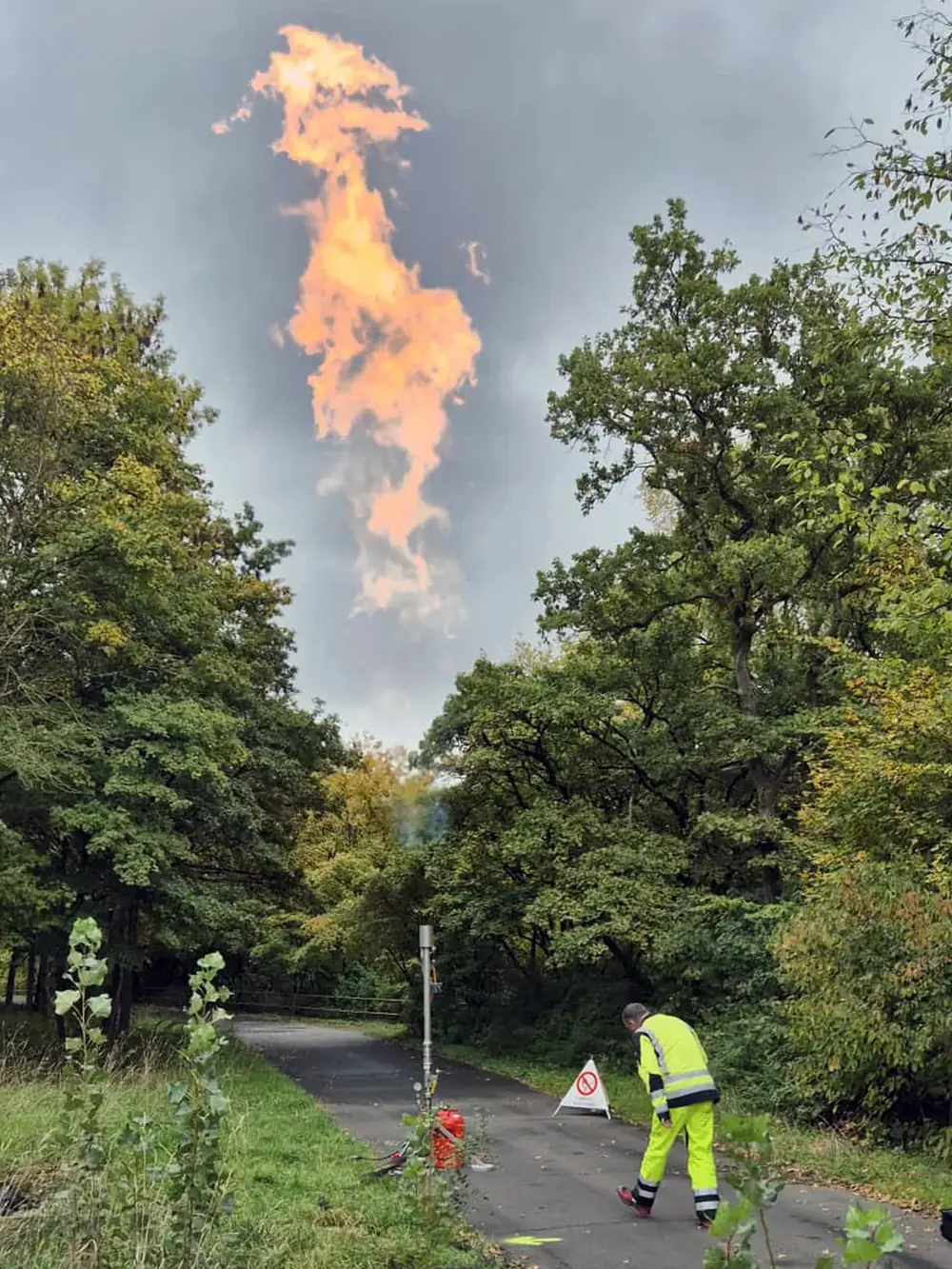
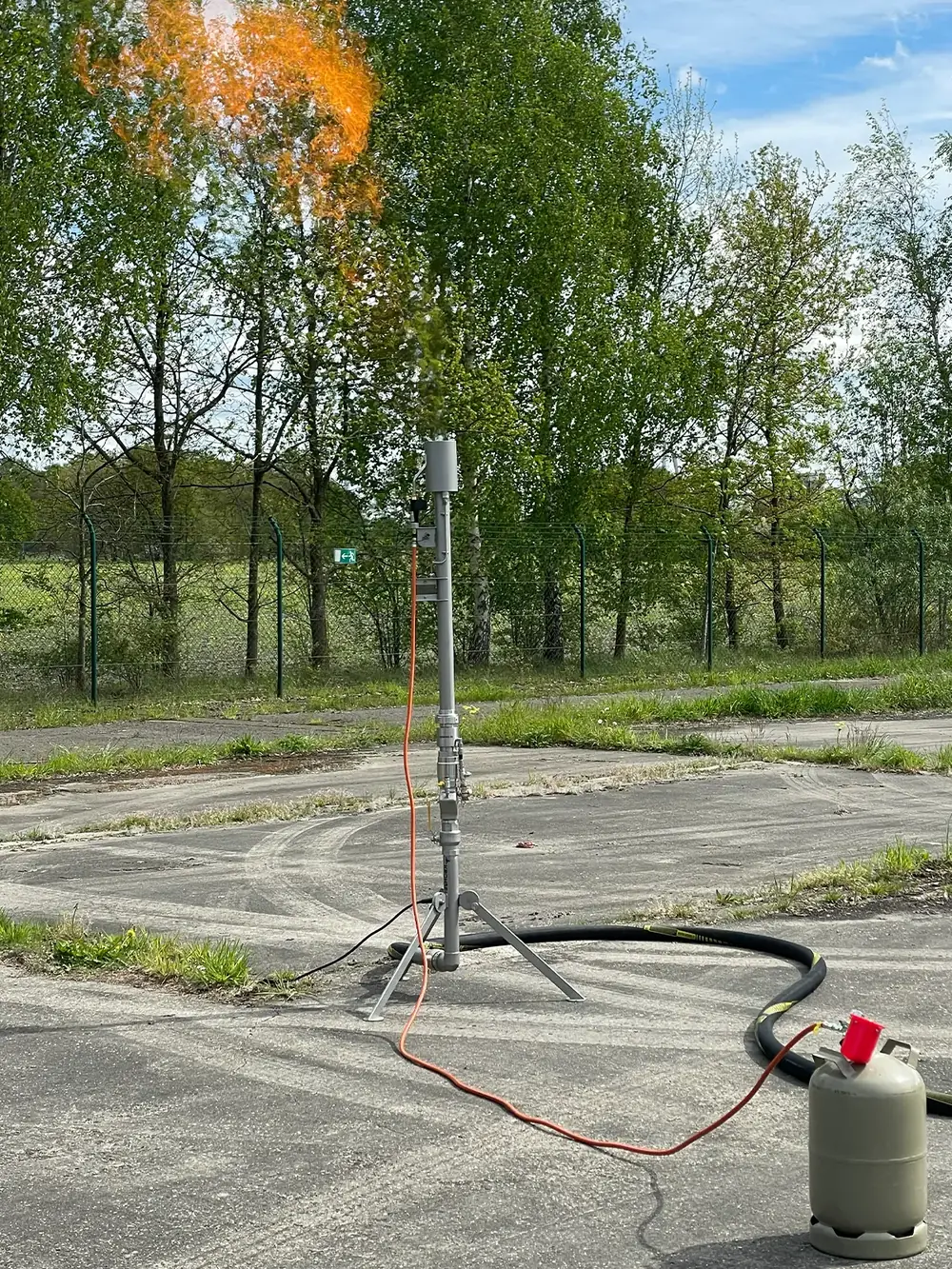
Both gas flares use a standing propane pilot flame that burns throughout the entire flaring operation. That is precisely why the regulation requires it: escaping gas is re-ignited at any time, even if the main flame briefly goes out. A 6 kg propane cylinder typically lasts 48 to 72 hours of continuous operation.
03
And the documentation obligation?
Flared volumes must be recorded and documented in a verifiable manner. The volume measuring case logs flow rate and quantity as a PDF alongside the flaring operation — for authorities, QM and audits.
What DBI measured
DBI test report no. 81-8108-2024 dated 19 Dec 2024. Limit under the EU Methane Regulation: no more than 1 % residual methane in the exhaust.
Feature
Highest measured residual methane
Burnout
Gasfackel DN 25
0,16 %
at least 99.8 %
Gasfackel DN 50
0,57 %
at least 99.4 %
On the DN 25, no residual methane was detectable from 0.5 bar flow pressure upwards. On the DN 50, the highest value was measured at flow rates up to 1,800 m³/h.
And in hydrogen operation?In January 2025 DBI additionally tested the DN 25 with pure hydrogen (99.9 %). At 100 to 360 m³/h and 0.10 to 0.40 bar flow pressure, unburnt residual hydrogen ranged between 13 and 0.5 ppm — DBI certifies complete burnout up to 0.4 bar and 360 m³/h. According to the report, hydrogen operation produces significantly higher NOx values than natural gas; for short-term flaring these are not subject to limit values.
What else Article 17 requires from the operator
The two requirements above concern the unit. Two more are addressed to you as the operator. We reproduce them here to the best of our knowledge — assessing them for your plant is up to you.
Flame monitor with a continuous pilot burner
“Where auto-igniters or continuous pilot burners are used, operators shall use flame monitors for continuous monitoring of the main flame or the pilot flame to ensure that no gas is released unburnt.”Article 17(4)
Our units work with a continuous pilot burner. The optical flame monitoring performs exactly this task — it is included in the PREMIUM PRO PLUS (DN 25) and PREMIUM-PRO+ (DN 50) versions. We recommend it; whether it is required for your application is your decision.
Inspection before every use
“Where the gas flares or other combustion devices are not used regularly, operators shall inspect them before each use.”Article 17(3)
Regularly used flares must be inspected every 15 days. Mobile units are usually deployed irregularly — then the check applies before every use. Any irregularities found must be rectified within six hours. We brief your team on this.
These statements reproduce the text of the regulation and do not constitute legal advice. How Article 17 applies to your plant is for you or your consulting engineer to assess.
Not sure whether your existing unit provides the evidence? Give us a call — we will go through the requirements with you.
02The equipment
Product range
Which gas flare suits your pipeline?
Two flare sizes plus matching system components — from house connections to the 100-bar pipeline. All units in stainless steel, multi-gas capable (natural gas, biogas, propane, town gas, hydrogen) and available in several versions.
Gas flares
DN 25 · 1"
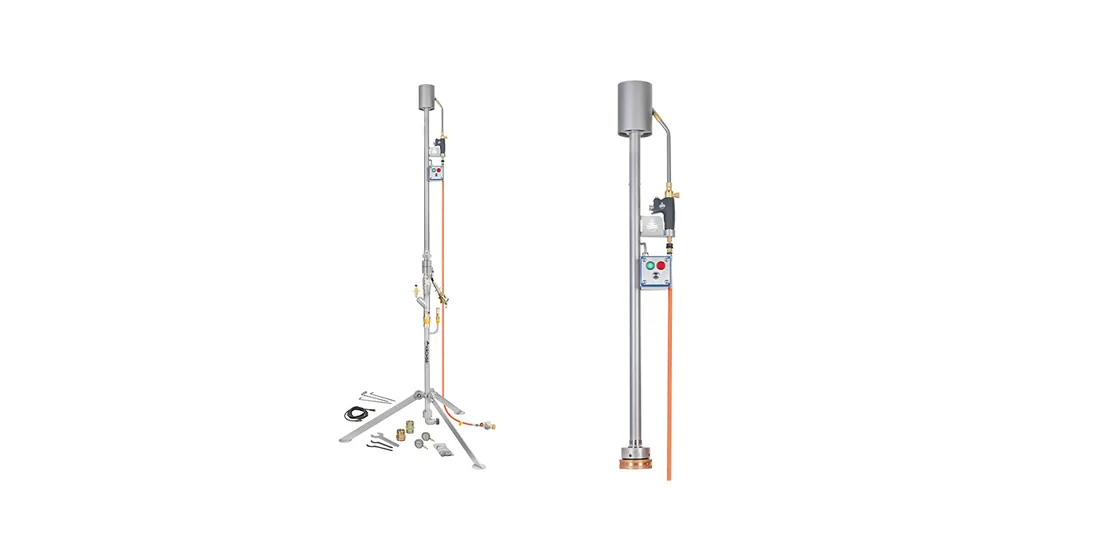
Gas flare DN 25
The mobile all-rounder for distribution grids and house connections — compact and quick to set up.
~700 m³/hat 5 bar flow pressure
5 mbar – 5 barpressure range
GRS25IBEDA · DVGW-certified
Stainless 1.4301 · piezo propane igniter
4 versions — ECO (brass) to PREMIUM PRO PLUS with VENKRO 25 venturi nozzle and flame monitoring
Why the measurement does not depend on the type of gas
A bluff body sits across the pipe. Behind it, vortices detach alternately to the left and right — a regular double row, named after the physicist Theodore von Kármán. Over a wide range, how often a vortex detaches depends solely on the flow velocity: twice the speed, twice the frequency.
Flow
Bluff body
0,3 m/s30 m/s
6,0 m/s·× 20vortices per second compared with 0.3 m/s
Watch this while dragging: the vortices do not move closer together. Their spacing is set by the width of the bluff body, not by the velocity — they simply pass by faster. That is precisely why more of them reach the sensor per second.
Schematic, not to scale. Behind the bluff body the vortices detach alternately from either side; the two rows rotate in opposite directions and are offset by half a spacing. The shedding frequency f follows f = Sr · v / d from the flow velocity v and the width of the bluff body d — the Strouhal number Sr stays nearly constant over a wide range. Which is exactly why: twice the velocity, twice the frequency.
Put simply
Hold a stick in a stream. Behind it, eddies form — one to the left, the next to the right, always alternating. If the water runs faster, the eddies follow each other faster. That is exactly what happens in the measuring case, only with gas: a bluff body sits in the pipe, and behind it the unit counts the vortices. The number of vortices per second gives the velocity; velocity times pipe cross-section gives the quantity. The same phenomenon makes a flag flutter in the wind and an overhead line sing in a storm.
The slider spans the unit's measuring range: 0.3 to 30 m/s in the measuring section. The figures are to scale. The motion in the picture is compressed — across the whole range the frequency changes a hundredfold, which at the upper end could no longer be followed.
The measuring case counts these detachments. Because only their frequency matters and not the force of the flow, the density of the gas is irrelevant. For flaring that is the decisive point: natural gas, biogas, propane and hydrogen differ in density by a multiple — a density-dependent method would have to be recalibrated for every type of gas.
You specify the gas — the device does not.For the conversion to standard cubic metres you enter into the device which gas you are flaring. It cannot verify this: it counts vortices, not composition. Whatever is entered, it takes as given. The wrong gas means the wrong standard value — and that value then appears in the report for the authorities.
All prices net, plus 19 % VAT · As of 07/2026 · Binding prices for all versions in the shop
You are not just buying a device.We configure it for your application. We service it, repair it and handle the annual inspection of the fittings — in our workshop in Leipzig. On the phone you reach someone who does the flaring himself. And when it is urgent, a hire unit is ready for collection within an hour. Anyone looking only at the purchase price will find cheaper. Anyone who wants the device to work when they are standing in front of it is in the right place.
Key features
What sets our flaring technology apart technically
Maximum flow pressure
DN 50 up to 16 bar, DN 25 up to 5 bar. Flow pressure is the pressure actually present at the unit while flaring — the higher it is, the greater the possible gas throughput.
Flow pressure = the pressure in the moving gas right at the unit (not the static pressure). It determines how much gas can be safely flared per hour.
On site
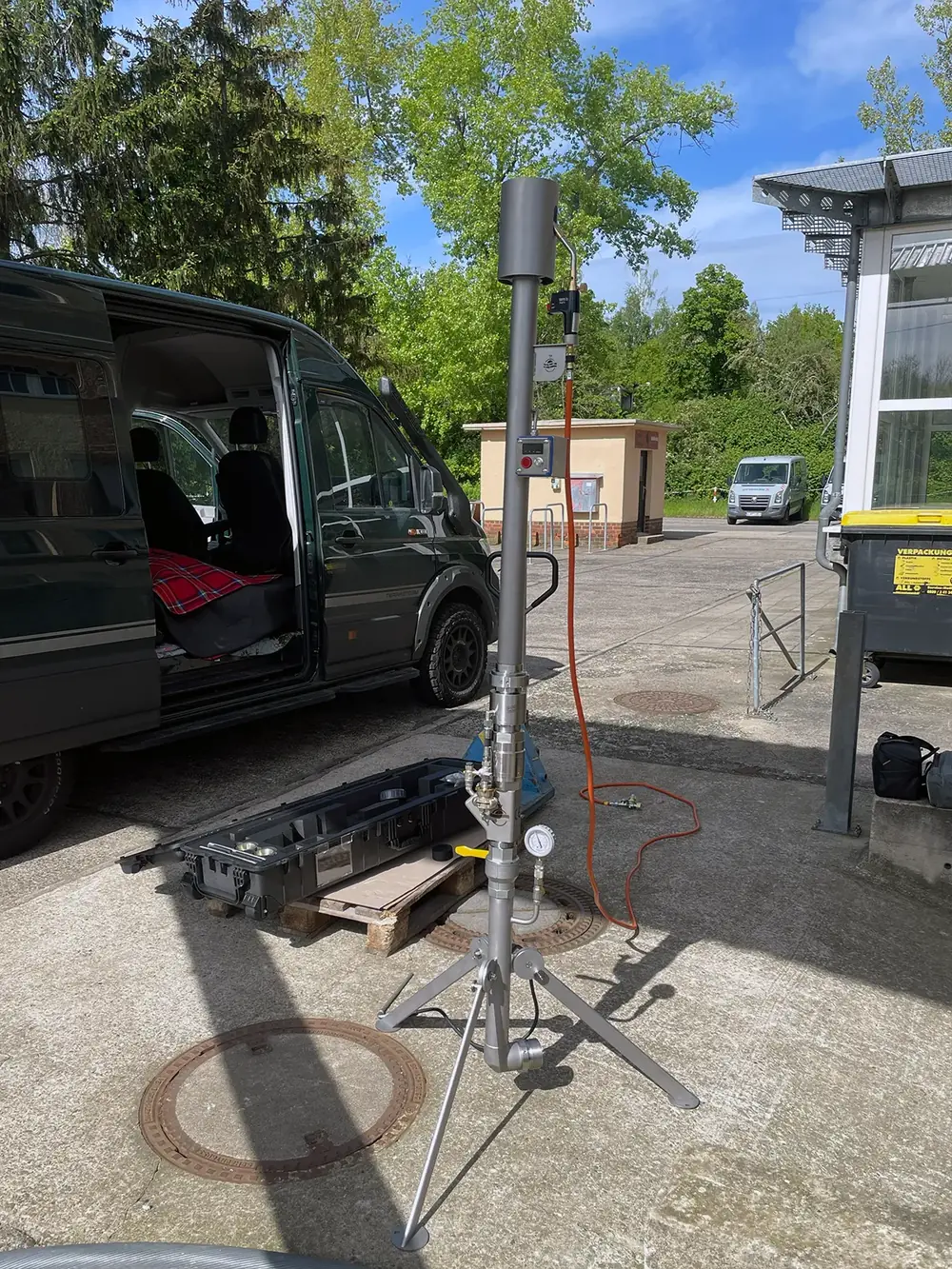
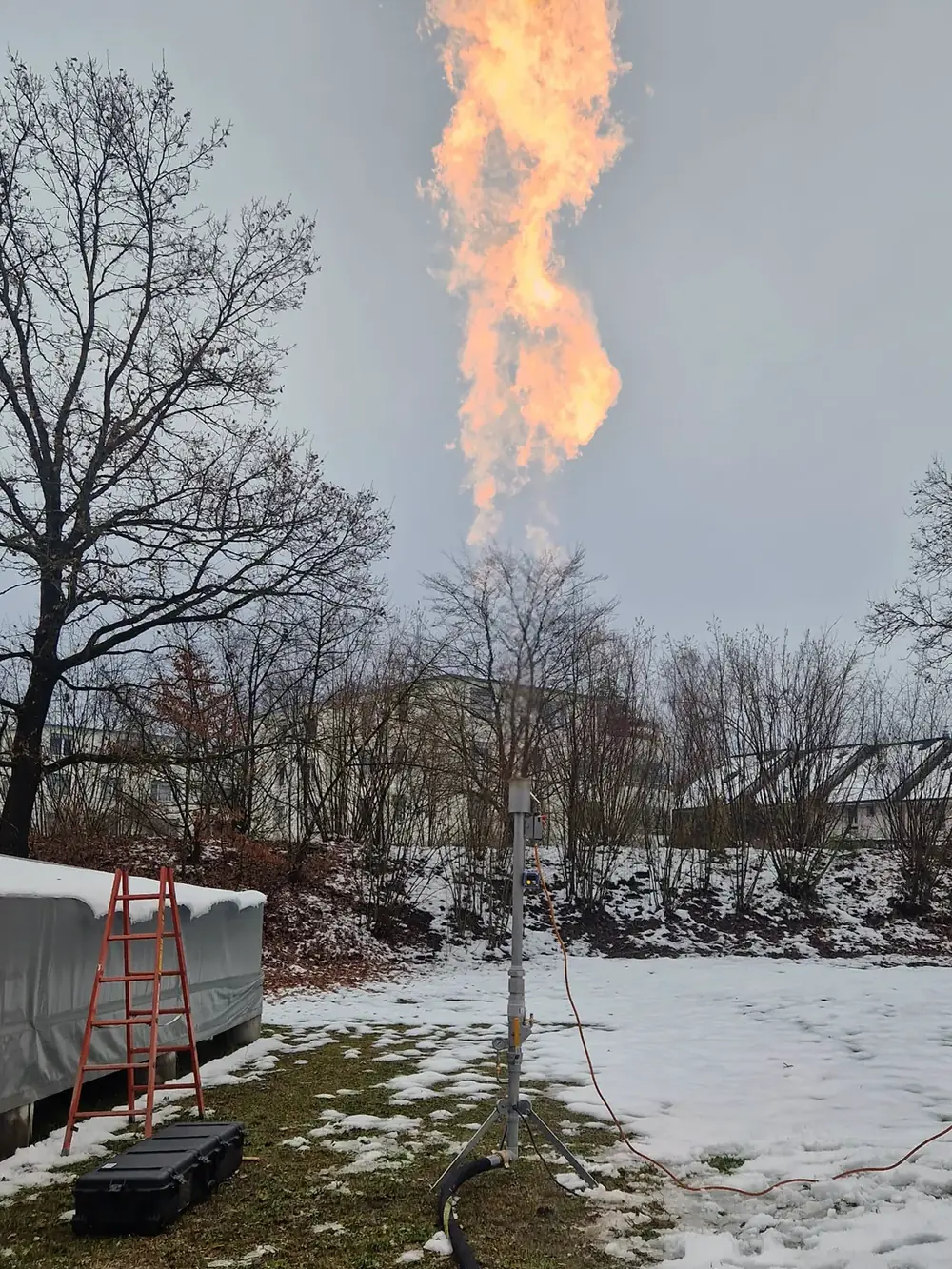
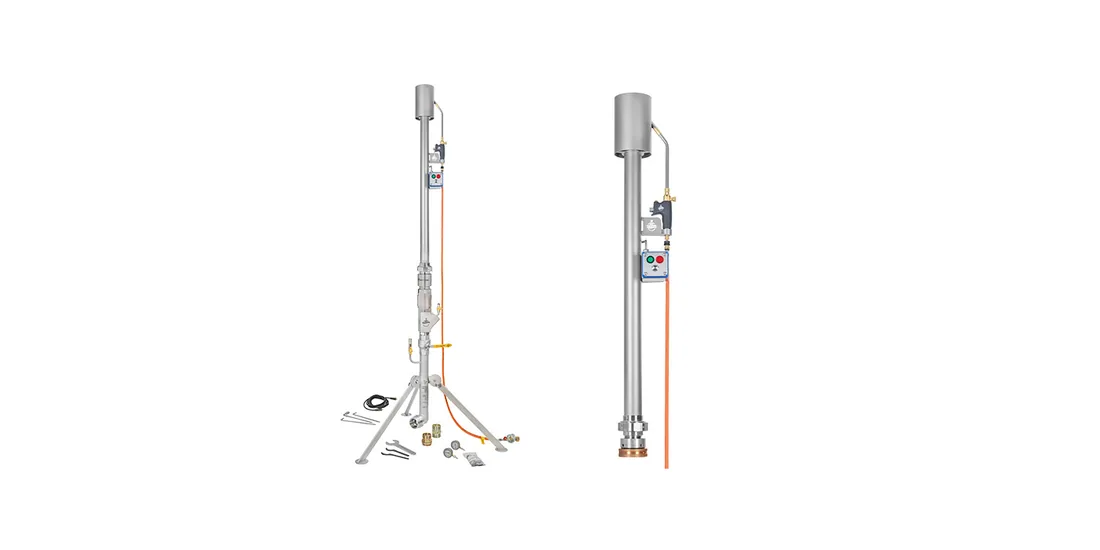
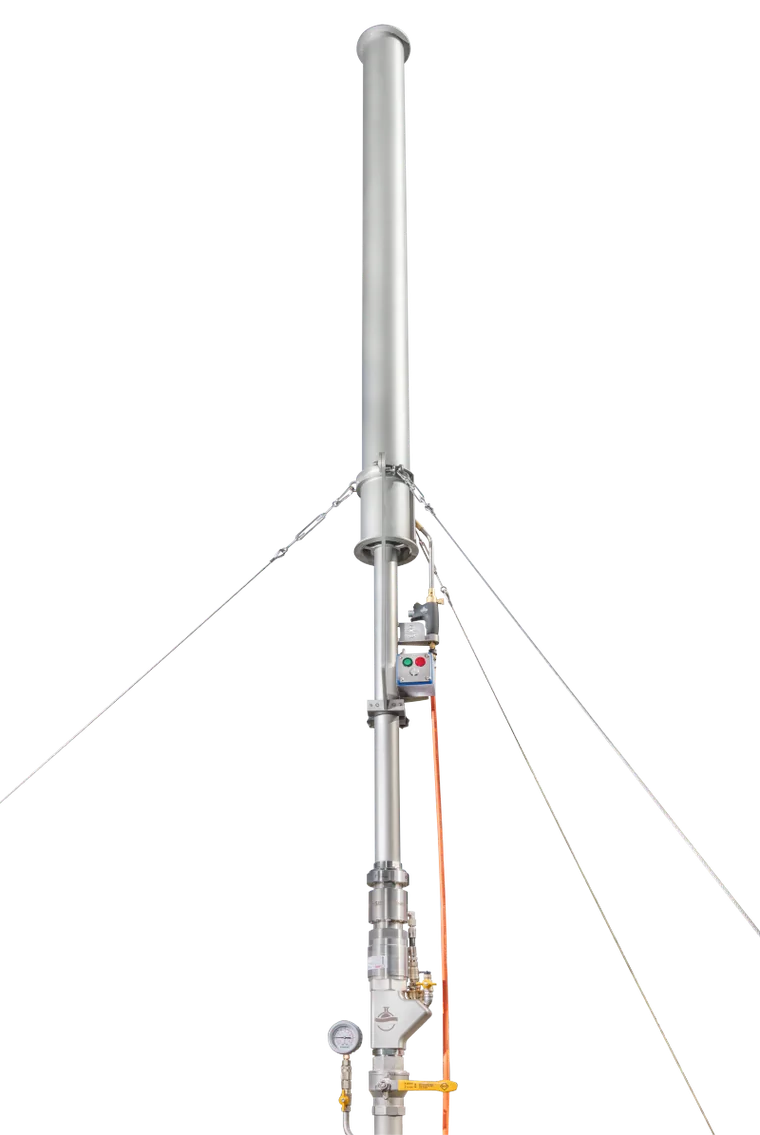
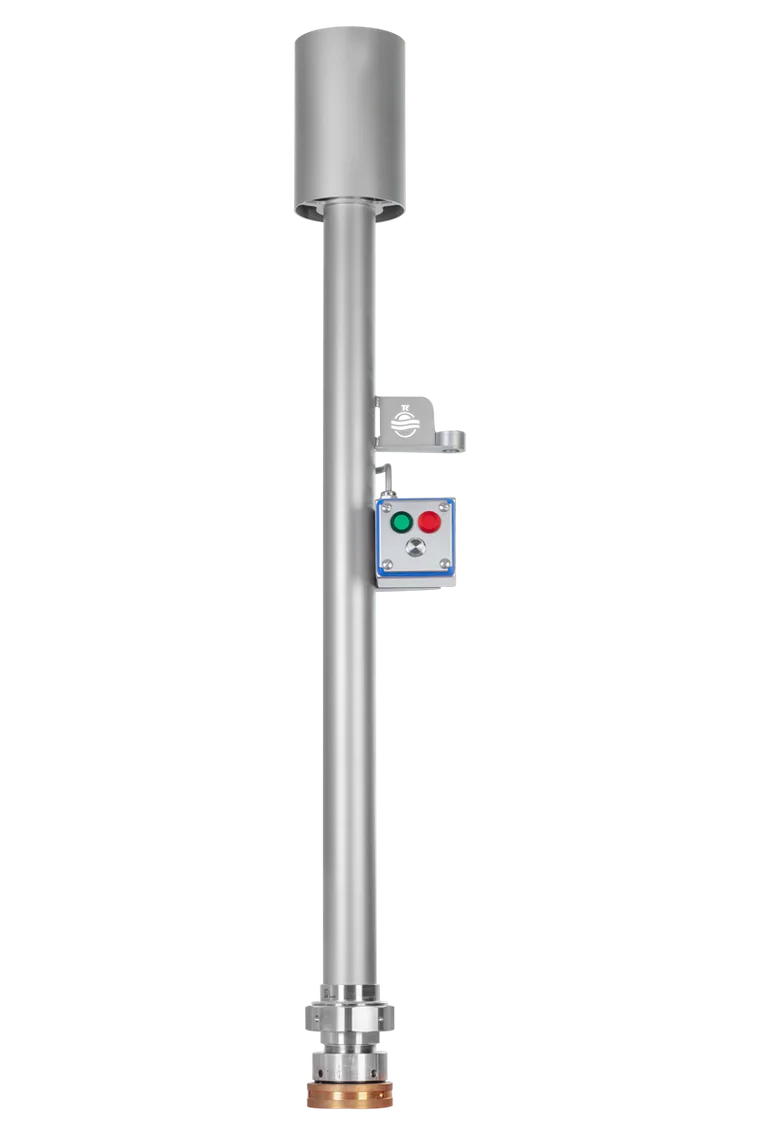
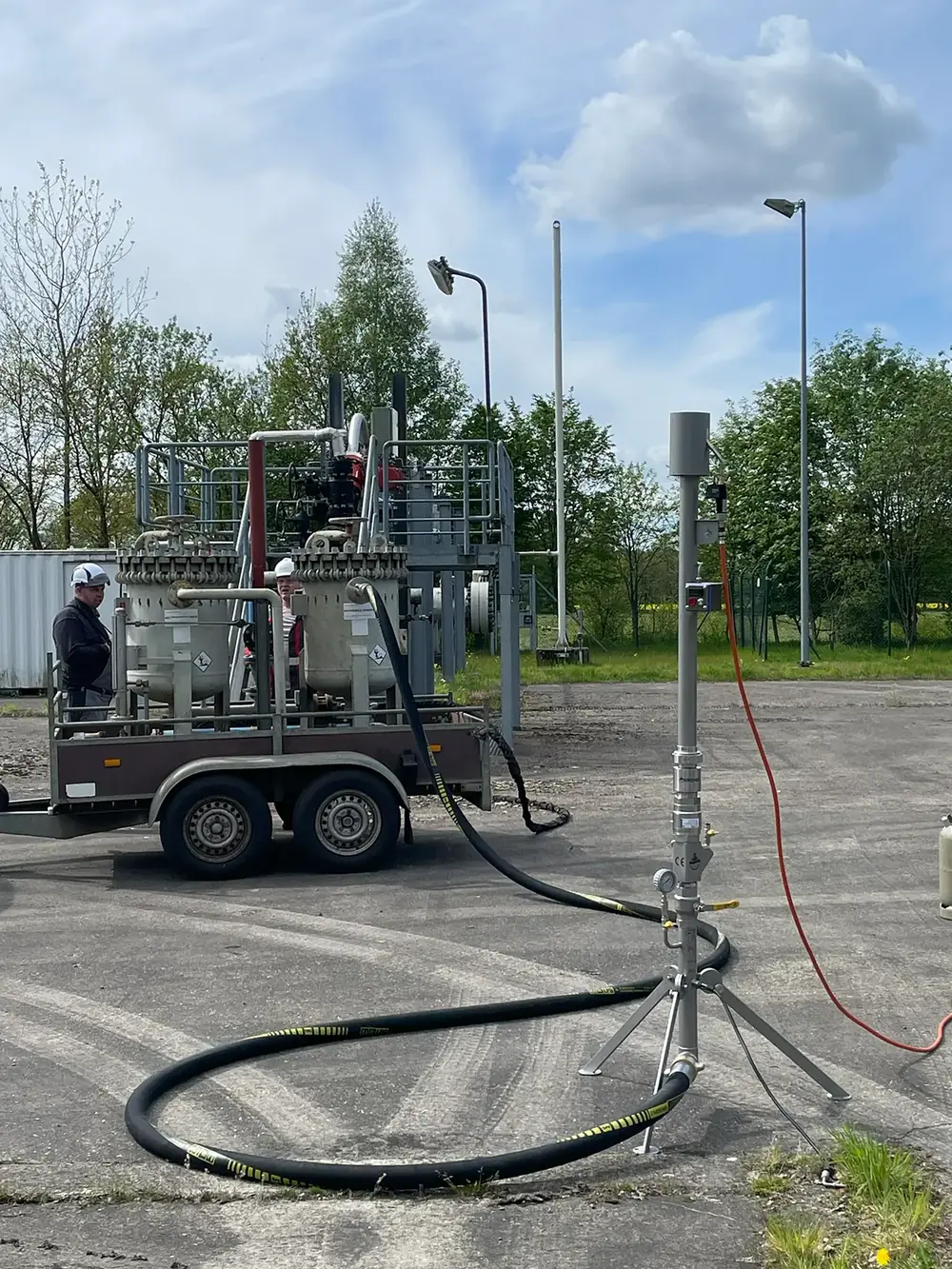
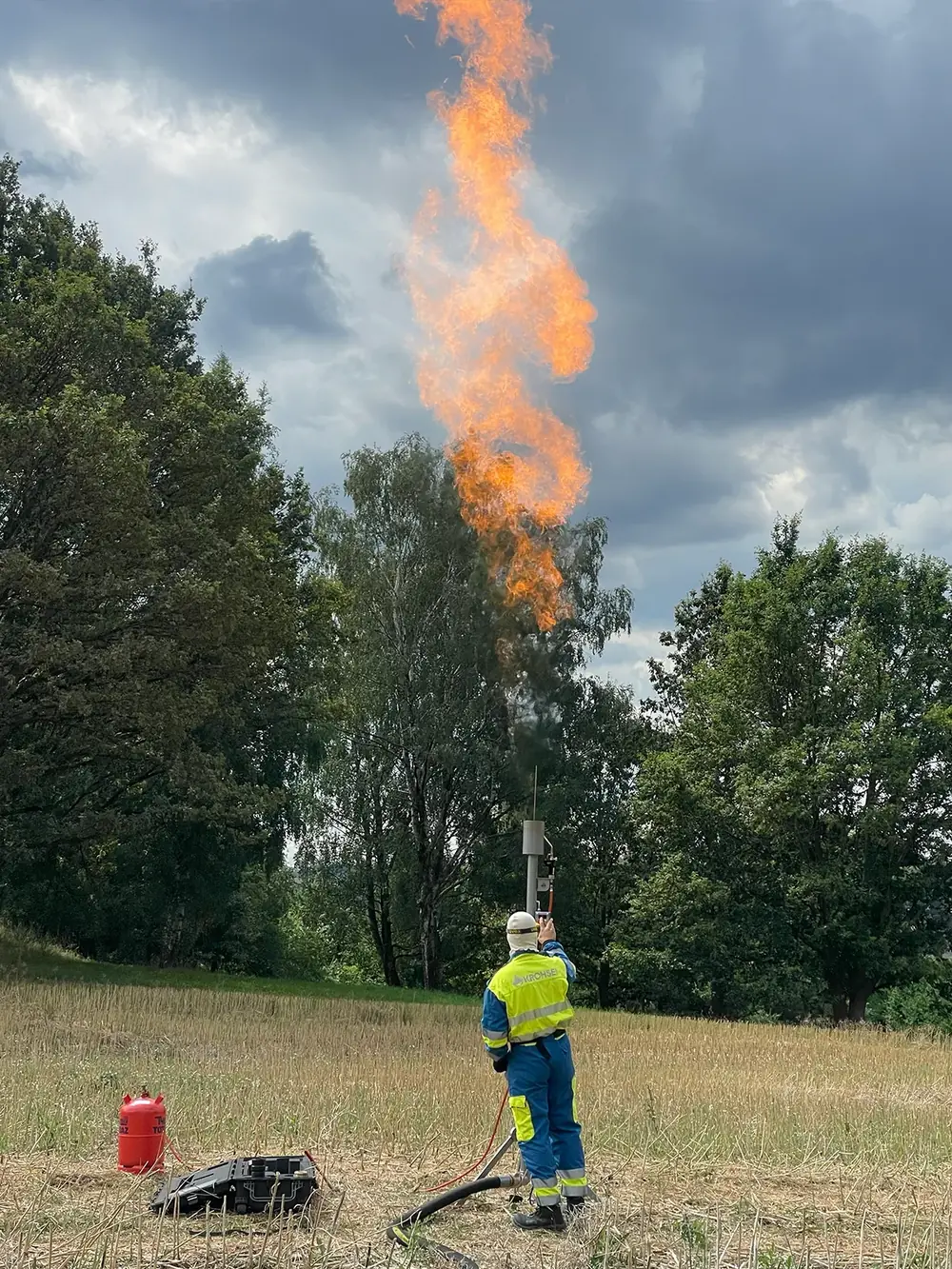
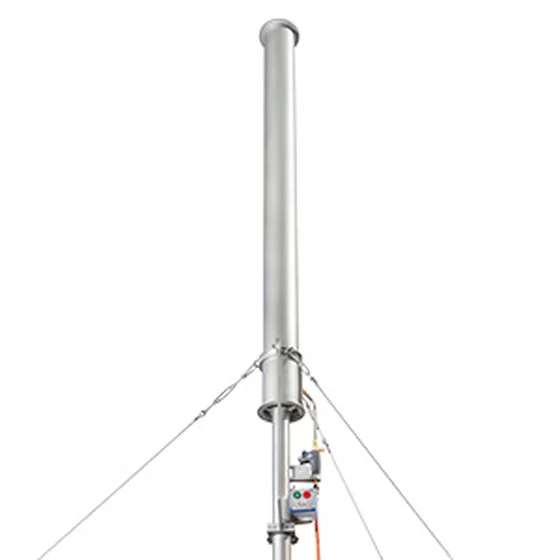
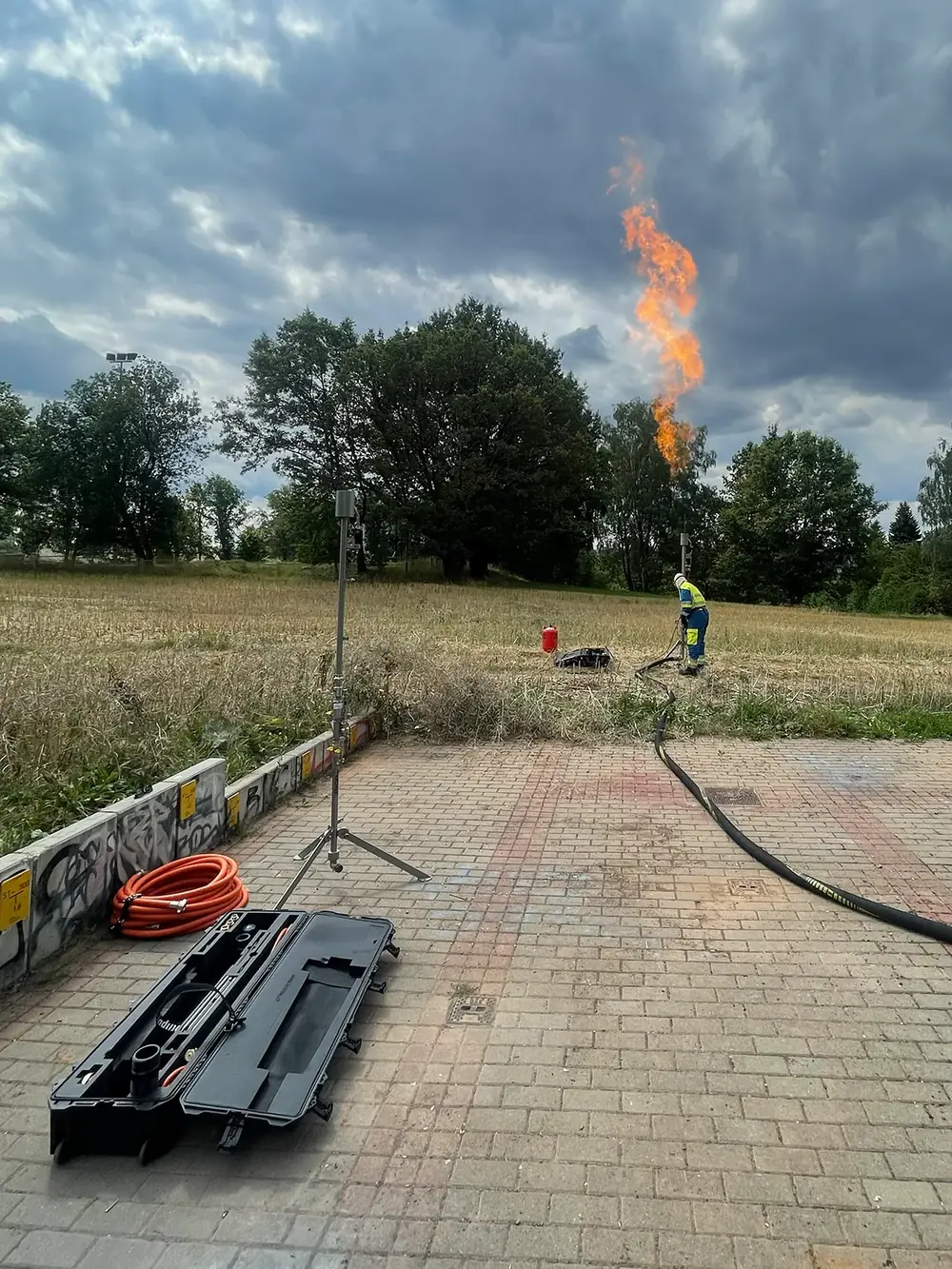
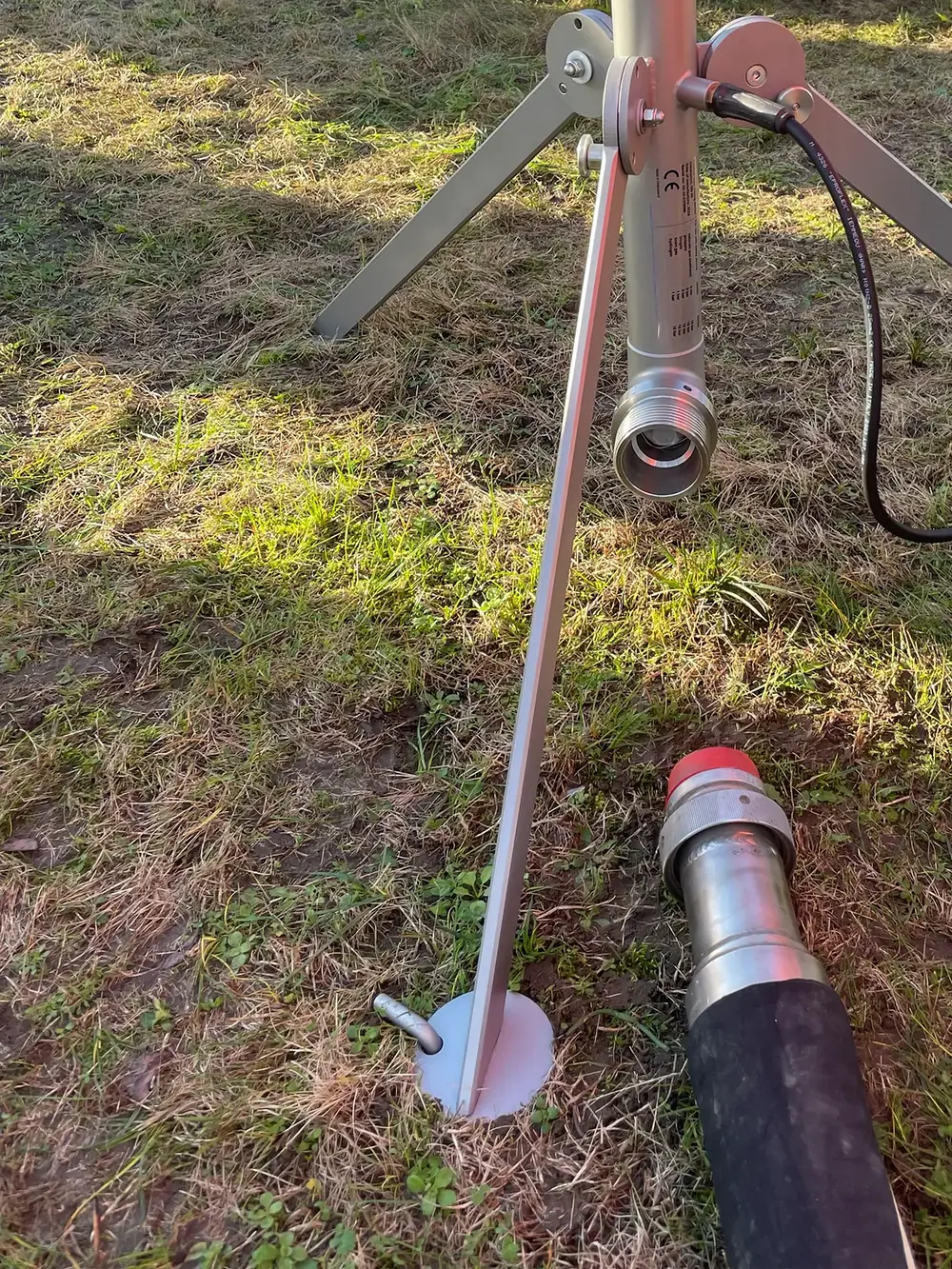
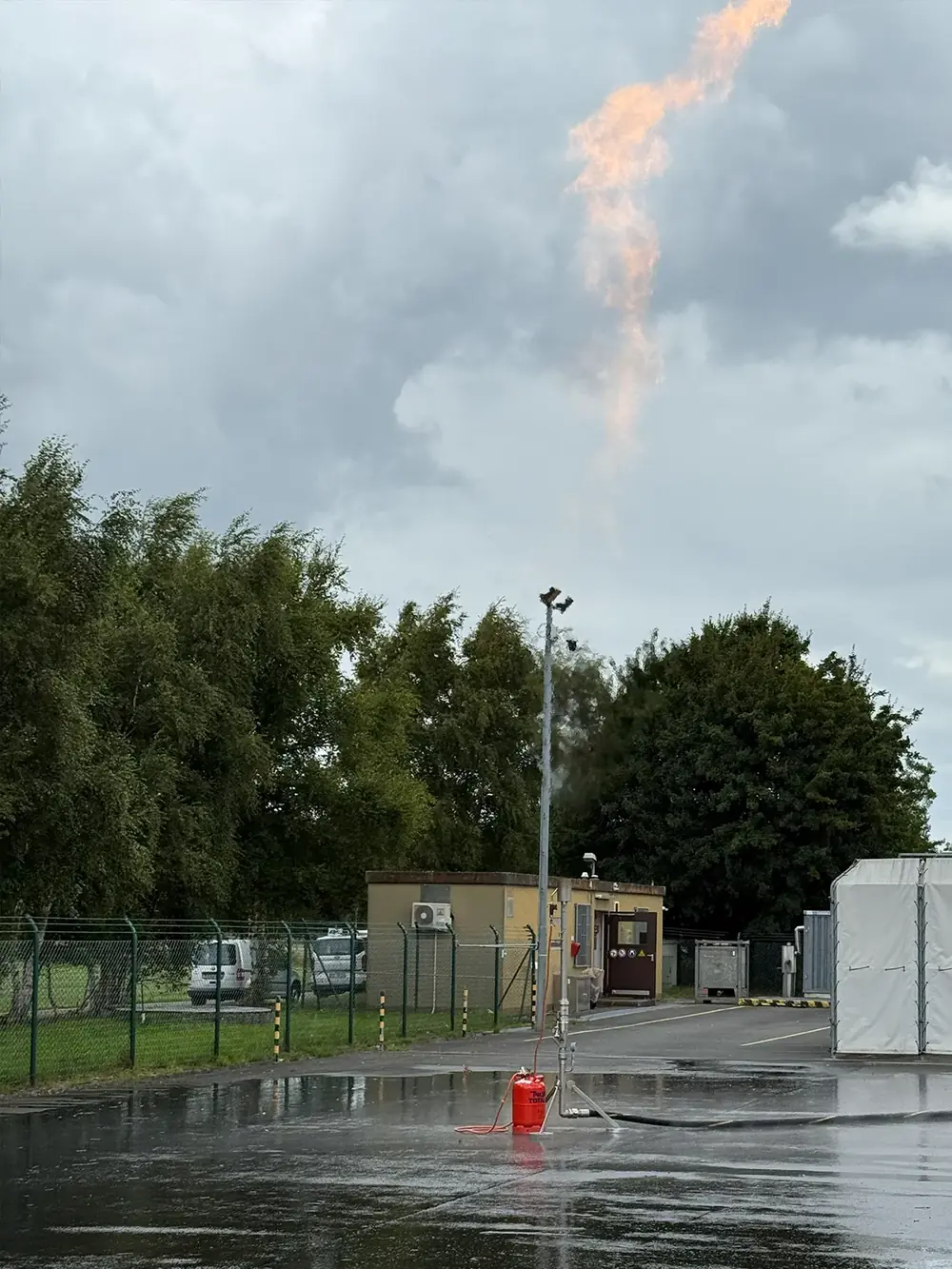
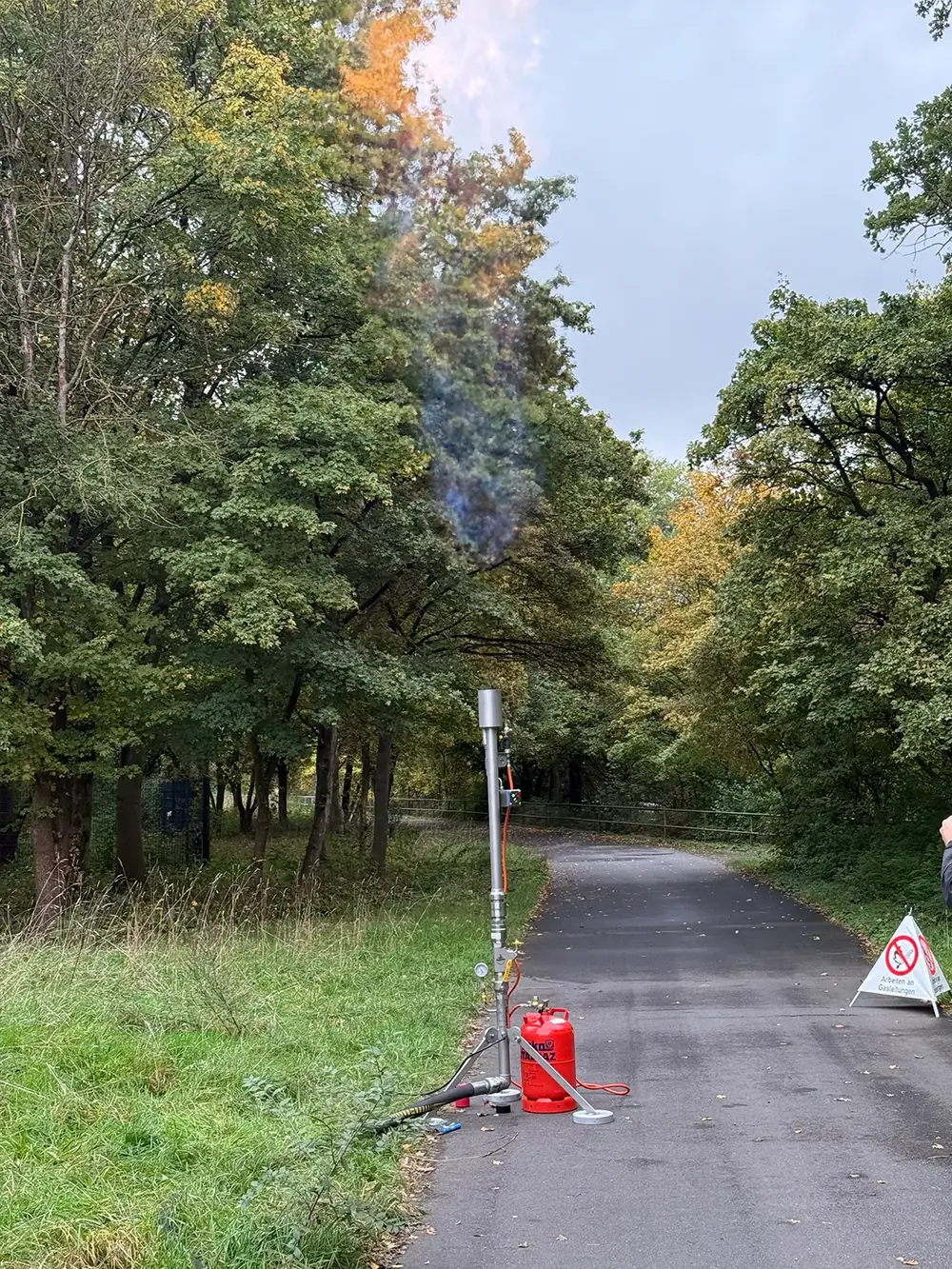
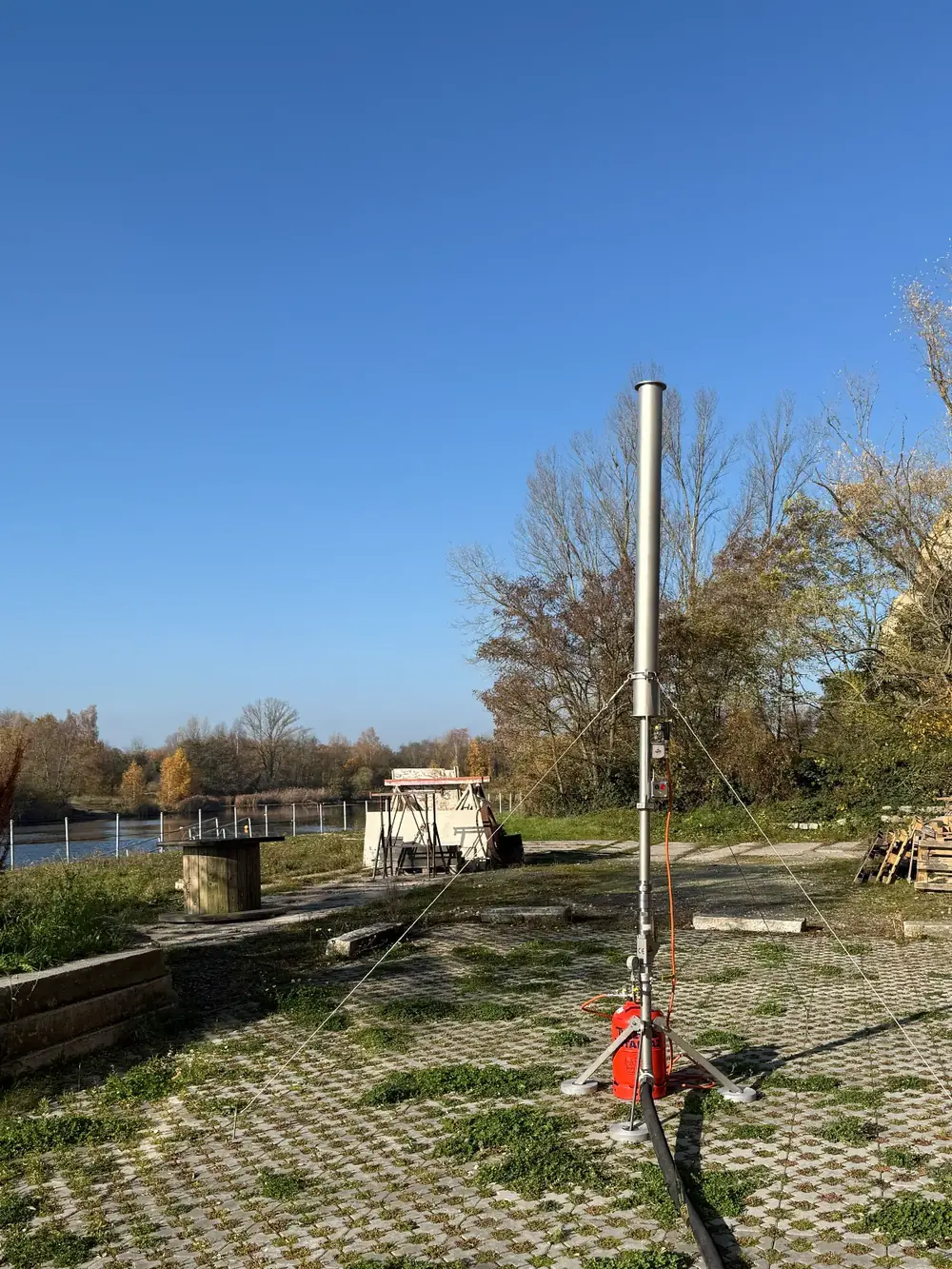
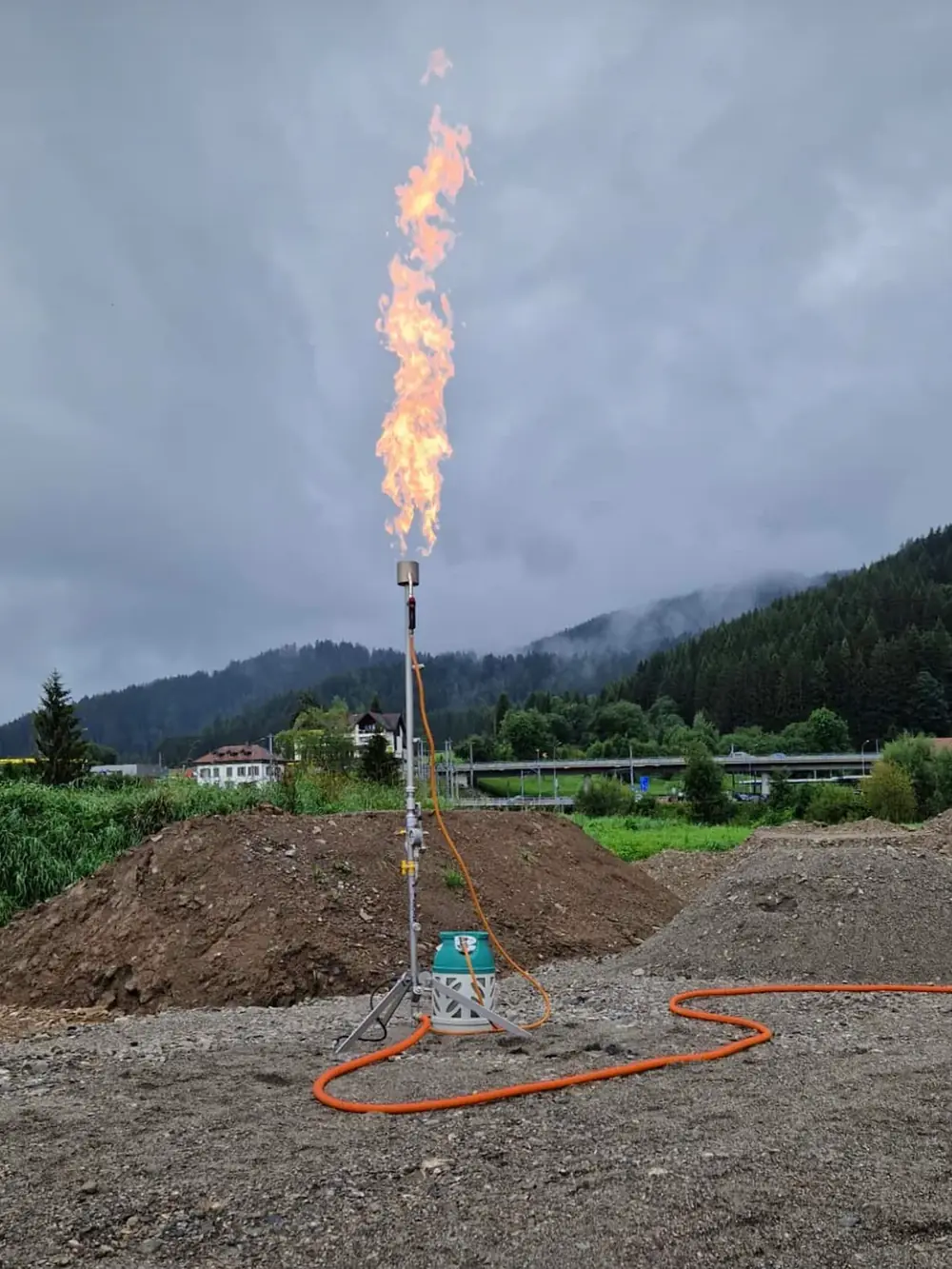
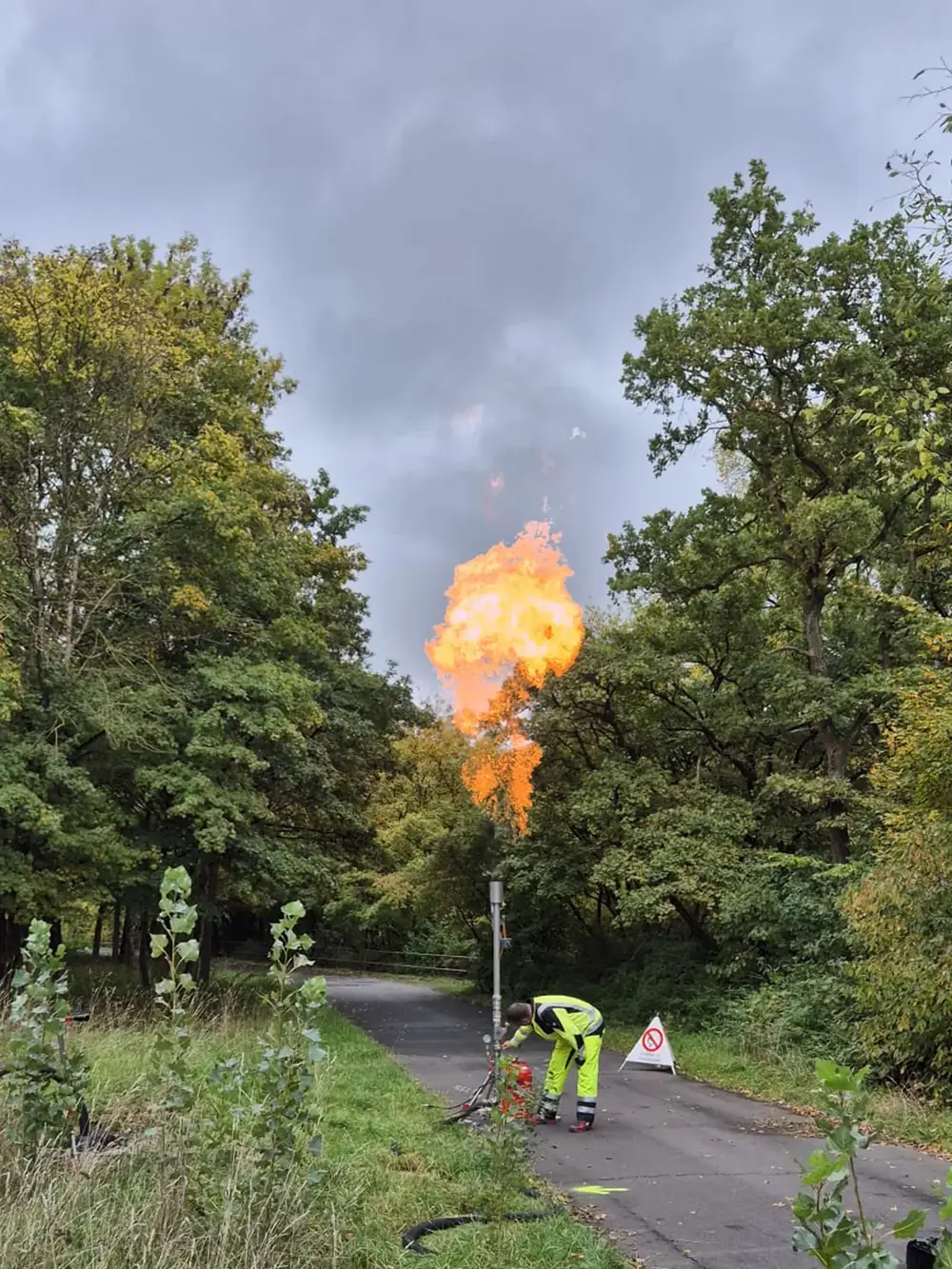
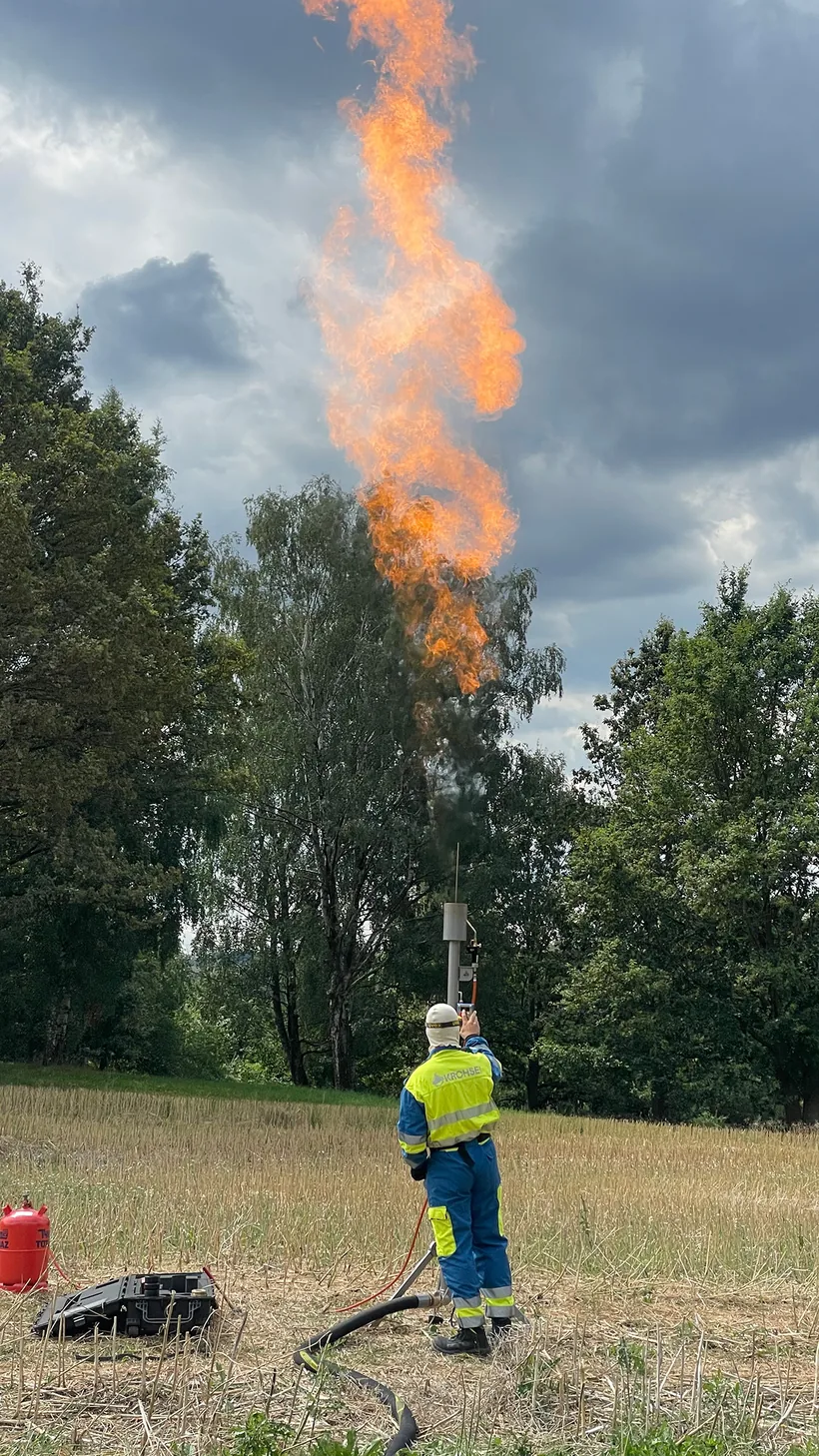
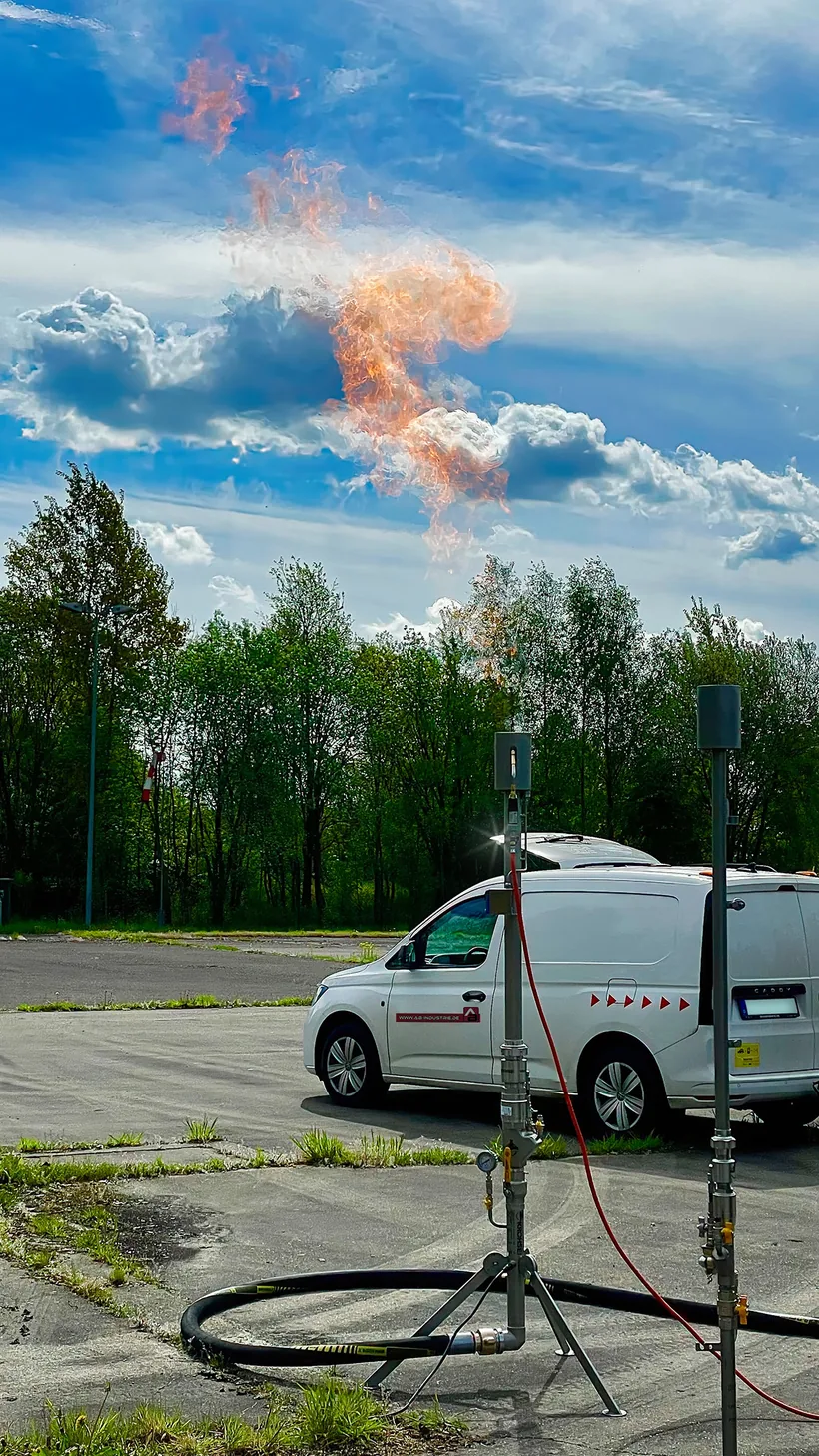
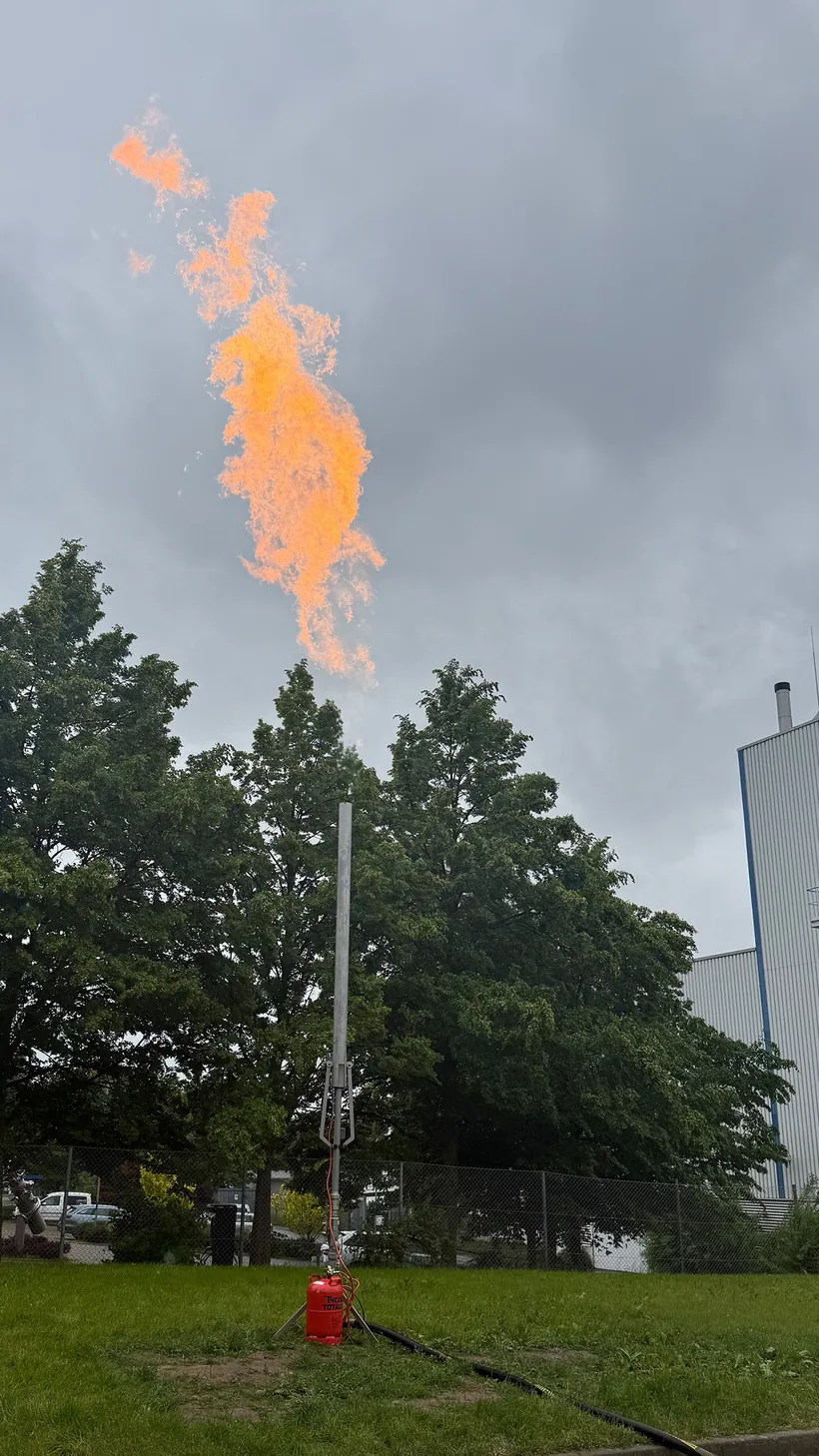
Shown: the upper riser with flame monitoring and the fitted diffuser extension tube (DN 50, +1,800 mm, stainless V2A). At high flow pressure the extension pushes the flame outlet further up — heat radiation moves upward and radiant heat at ground level drops noticeably. Guyed with three eyelets, use from 1 bar line pressure.
Venturi nozzle – empty down to ppm
The venturi nozzle — VENKRO 25 for the DN 25, VENKRO 50 for the DN 50, both patent pending — actively draws the residual gas out of the line, down to the ppm range and thus far below 50 % LEL. A separate nitrogen purge can be dispensed with: no cylinders to order, transport, connect and return.
Venturi nozzle = a constriction where flowing compressed air creates a vacuum and draws residual gas out of the line — without any pump.
On site
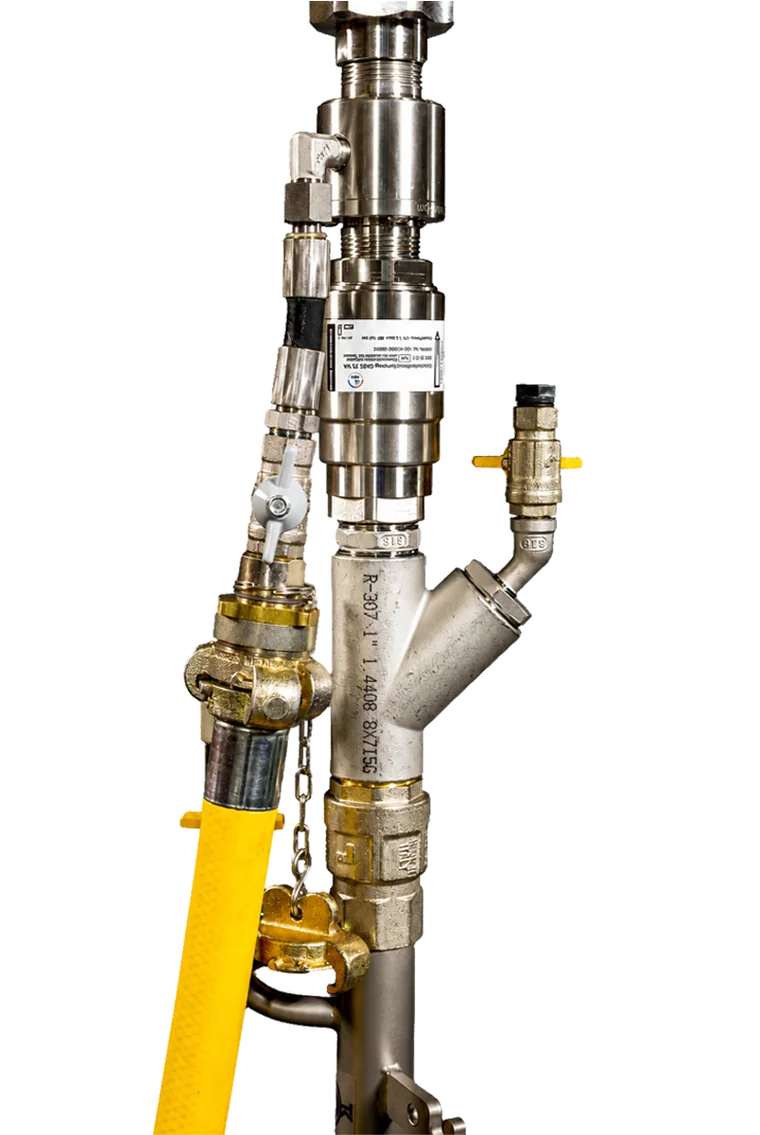
Shown: the Venturi nozzle with compressed-air connection. How to draw down the line — oil-free compressed air creates a vacuum in the nozzle and pulls residual gas out of the line. Use only oil-free site compressors at 8–16 bar and at least 1.6 m³/min. Open a vent at the far end of the line. When the primary flame goes out: close the air, measure the gas concentration — only shut down below 50% LEL.
Optical flame monitoring
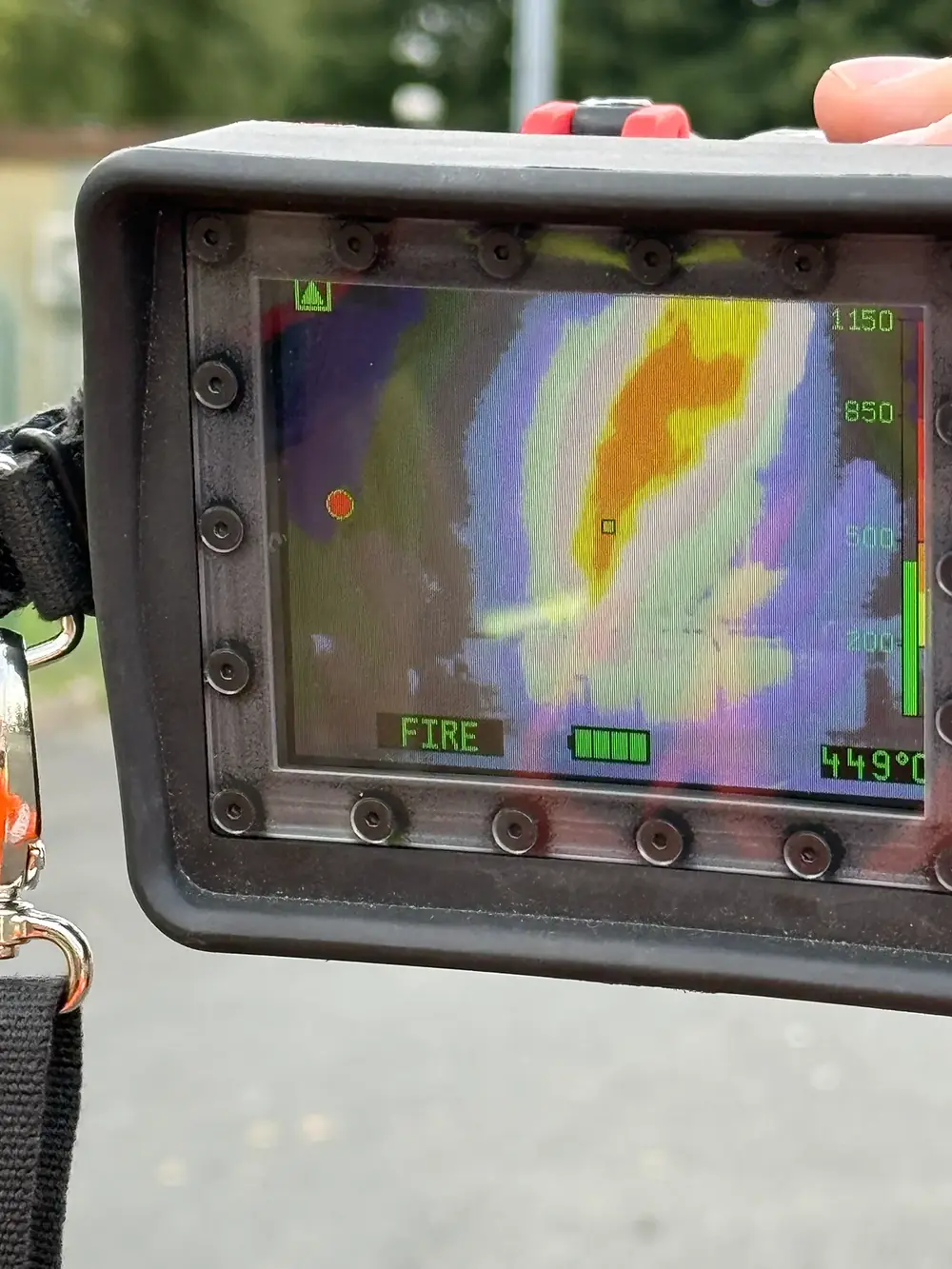
Optional for both units — optical monitoring reliably checks the flame, even with hard-to-see gases such as hydrogen.
Optical flame monitoring = a sensor detects via light/UV whether the flame is burning and reports any flame-out immediately.
On site
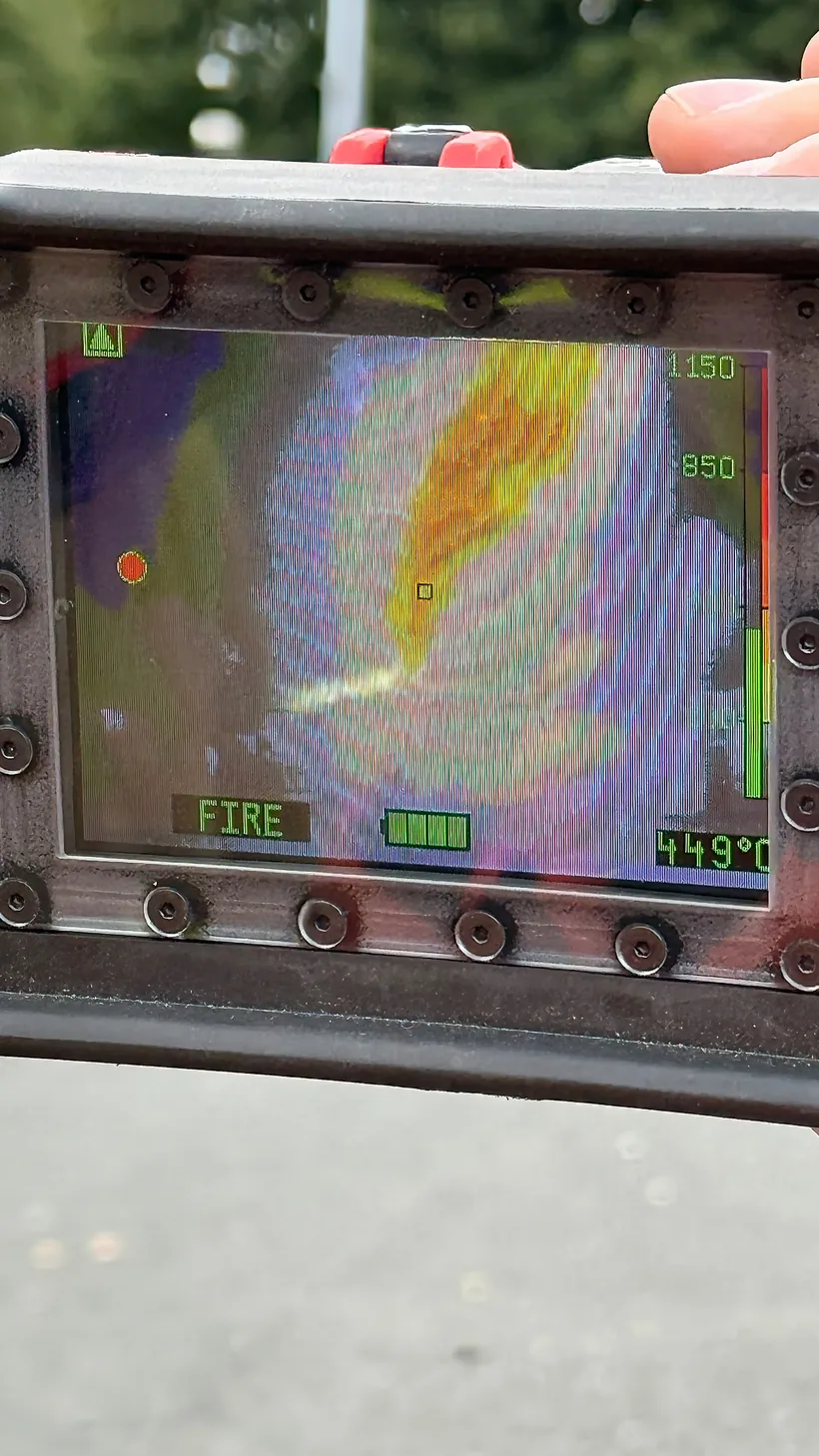
Shown: the display of the optical flame monitor. Press the central main switch — red LED = battery OK, no flame detected (including methane and hydrogen), green LED = flame burning. The LiFePO4 battery lasts about 120 hours of continuous operation; recharge after 20 days of non-use at the latest.
Ready in 2 minutes
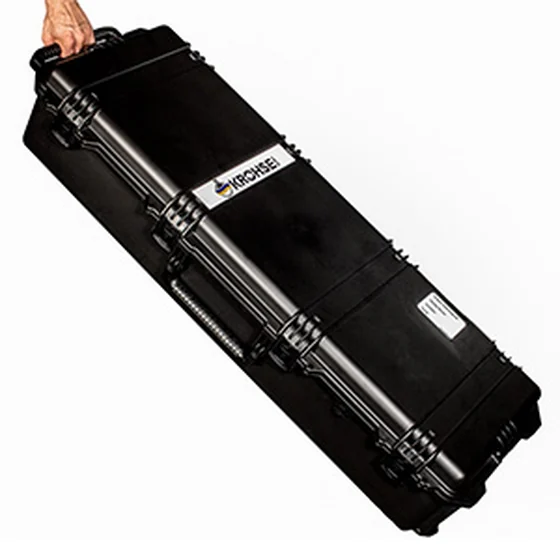
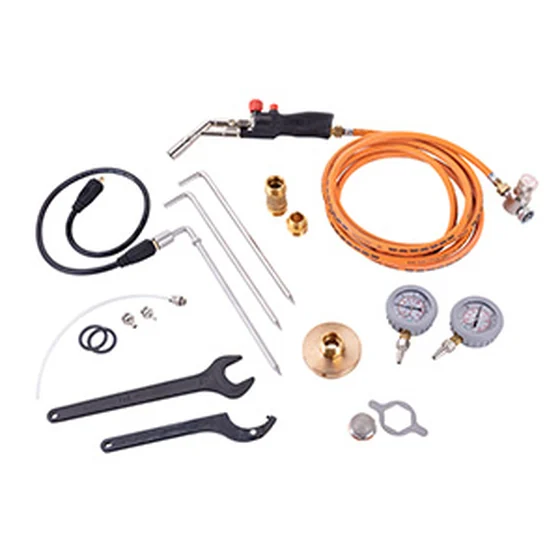
Quick setup — the unit is ready to operate in about two minutes. The necessary tools are included in the case, ideal for changing sites.
Everything from one source
Advice, maintenance and service straight from AB Industrie — short routes, easy to reach and dependable.
Briefings & training
We brief your team and train the safe handling of flaring technology — hands-on and on-site on request.
Technical data
DN 25 or DN 50 — compared directly
Configurator
Which version do I need?
Five answers are enough. You get the matching version with its part number and the accessories to go with it — and can request the whole package.
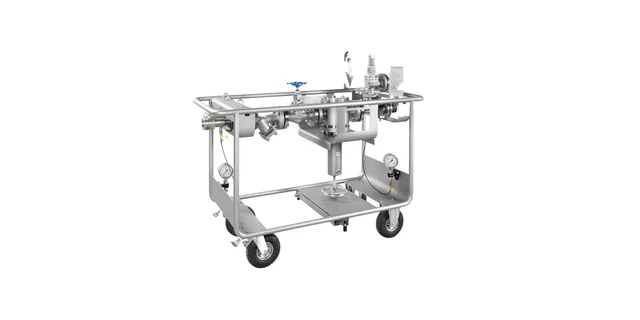
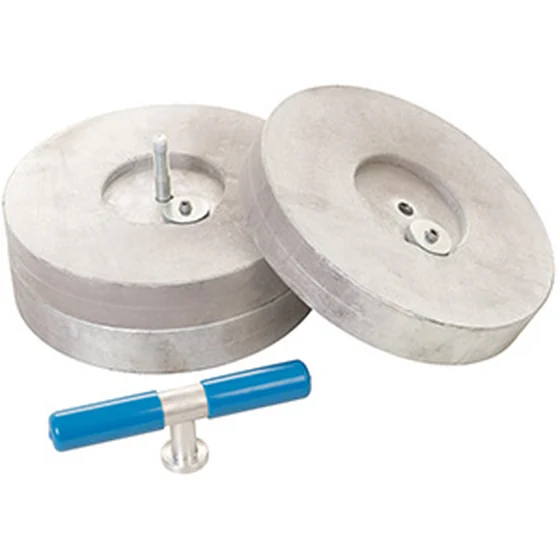
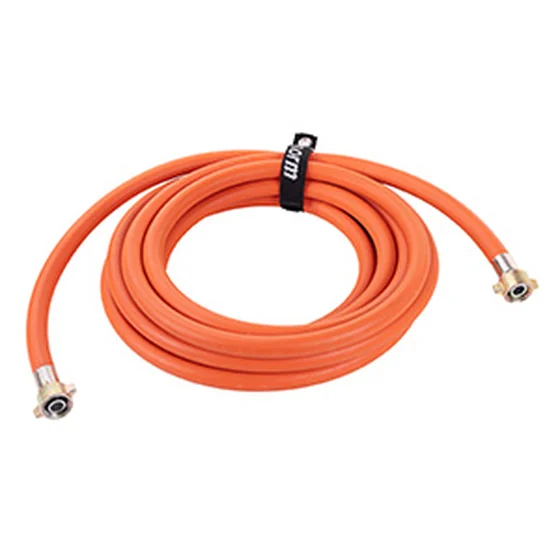
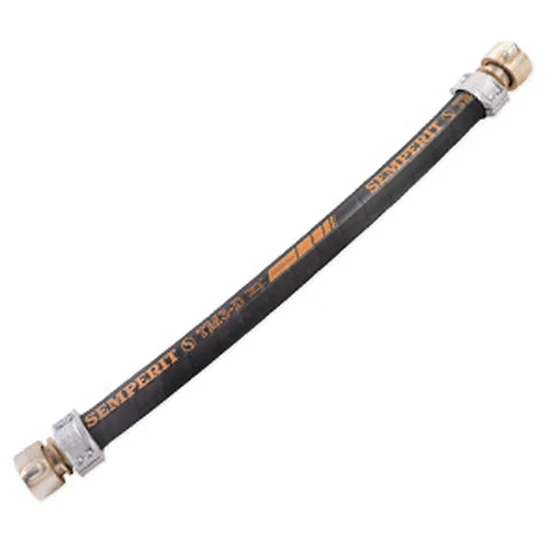
Let's settle that on the phoneStatic pressure and flow pressure are two different things — and what matters for the choice of unit is the flow pressure at the unit. Tell us the job and the line, and we will tell you what fits.I am not sure about the line pressure and would like an assessment.Up to around 700 m³/h at 5 bar flow pressure the DN 25 is enough.Above around 700 m³/h the DN 50 is the right size.Above 5 bar line pressure only the DN 50 will do. Otherwise you would need an upstream pressure reduction — a second unit to transport, set up and add to the risk assessment.Above 16 bar the mobile pressure reduction station goes in front: it brings up to 100 barg down to a safe flaring pressure, with ATEX-certified fittings.The venturi nozzle draws the residual gas actively out of the line — a separate nitrogen purge can then be dispensed with.Optical flame monitoring detects the flame even where it is barely visible to the naked eye. Whether it is required for your application is for you or your planner to judge.On the DN 25 flame monitoring is only available together with the venturi nozzle — hence PREMIUM PRO PLUS.If it does not have to be stainless steel: the ECO version has the IBEDA safety fitting in brass, part number 960800-001.At your pressure the 5 bar version would also do. We still recommend the 16 bar variant: the surcharge is 175 €, and you will not be held up by the next line above 5 bar.We will quote the pressure reduction station on request — it is configured to match your inlet pressure.You left the quantity open. If you regularly flare more than 700 m³/h, do mention it — then we will check the size again.I am interested in the {geraet} in the {variante} version, part number {nummer}. Selected via the configurator on torching.de.Venturi nozzleOptical flame monitoringVolume measuring caseMobile pressure reduction stationDiffuser extension DN 50Ballast plates, set of 3Degassing hose DN 19Degassing hose DN 50Hydrogen hose — not from usDraws the residual gas actively out of the line.Detects the flame even where it is barely visible.Measures and records the quantity as a PDF.Brings up to 100 barg down to a safe flaring pressure. Price on request.For the DN 50 flare only. Raises the flame outlet by 1,800 mm; use from 1 bar line pressure.Secure the stand on hard or uneven ground.GWPB 19 × 4.5 mm, PN 20, ISO 3821 — length of your choice.50 × 8.5 mm, EN 1762:2018 · CE — length of your choice.We do not supply hoses for hydrogen. We refer you to Mordhorst.We will agree the right hose with you.The diffuser extension is only available for the DN 50.Flared quantities must be reported under Article 16 of the EU methane regulation. Without the measuring case you will need another solution for that.You left the ground open. On asphalt or concrete the ground spikes will not hold — then the ballast plates belong in the package.The unitDN 25 up to about 700 m³/h, DN 50 above that.Up to 5 bar both sizes are possible — the line falls at roughly 700 m³/h of flared volume. Tell us the volume and we will settle the size.I am interested in a mobile gas flare. Line pressure is up to 5 bar; I do not yet know the volume to be flared — I would clarify the size with you. Selected via the configurator on torching.de.Degassing hoseUp to about 700 m³/h the DN 25 would do — but the diffuser extension exists only for the DN 50. So both are shown: without the extension the DN 25, with it the DN 50.For the DN 25 flare.For the DN 50 flare.I am interested in a mobile gas flare. Line pressure is up to 5 bar, the volume to be flared around 700 m³/h. I need the diffuser extension, and that exists only for the DN 50 — so both sizes are listed here. Which one it becomes I would clarify with you. Selected via the configurator on torching.de.Not approved for hydrogen.We assumed natural ground — ground spikes are included for that. On asphalt or concrete the ballast plates belong with it.· Mon–Fri from 8 a.m.Gas flare DN 25Gas flare DN 50Advice / OtherIncluded in the package
A pre-selection, not a binding specification. What counts is the flow pressure at the unit — if in doubt, give us a call.
Flow rates (≈ 700 / 2,000 m³/h) apply at 5 bar flow pressure at the flaring unit and are DBI-tested in this range (DBI tests up to 5 bar). The DN 50 operates up to 16 bar flow pressure — so significantly higher throughputs are possible.
Feature
Gasfackel DN 25
Gasfackel DN 50
Nominal size
DN 25 (1")
DN 50 (2")
Flow at 5 bar
~700 m³/h
~2.000 m³/h
Pressure range
5 mbar – 5 bar
5 mbar – 16 bar
Flashback arrestor
up to 1.5 bar H₂ · 5 bar methane/biogas/propane
not required by design
Non-return safety
bis 5 bar
bis 16 bar
Safety valve
GRS25 (IBEDA) · DVGW
GRV50 (IBEDA) · DVGW
Ignition
Piezo propane igniter
Piezo propane igniter
Flame monitoring
optional optical
optional optical
Gas types
Natural gas · biogas · propane · town gas · H₂
Natural gas · biogas · propane · town gas · H₂
Connection hose · standard
ISO 3821 (EN 559)
EN 1762:2018 · CE
Temperature range
−20 °C … +70 °C
−20 °C … +70 °C
Material
Stainless 1.4301, bead-blasted
Stainless 1.4301, bead-blasted
Total height
2.140 / 2.230 mm
2.145 / 2.240 mm
Weight (unit + trolley)
15 + 15 kg
38 + 27 kg
Transport trolley (L × W × H)
1.190 × 492 × 222 mm
1.458 × 469 × 285 mm
Pre-filter
0.1 mm · on the main pipe
0.1 mm · in the hose connection
Typical use
Distribution grids, house connections, small tanks
Transmission / high-pressure lines, pipelines
Rule of thumb:For residual-gas volumes up to roughly 700 m³/h (at 5 bar) the DN 25 is sufficient. If you regularly flare larger flows or work at high pressure, the DN 50 is the safe choice — and it also covers the DN 25 range for mixed use.
When does a gas flare need a flashback arrestor?It depends on whether the flare tube is open at the top. On the DN 50 it always is: no back pressure can build up that would let a flame travel back into the line. A flashback arrestor is therefore not required by design – the unit carries the IBEDA GRV50 gas non-return valve, and in the 5 bar version the GRS50 safety fitting to DIN EN ISO 5175-2. Before every job you have to check that the flare tube is clear anyway. There is no silencer for the DN 50. The DN 25 comes with a screw-in silencer in its case. Once it is fitted, the system is no longer open at the top – and then a flashback arrestor is mandatory. Without the silencer the same applies as for the DN 50.
Transport and carryingThe trolley rolls. If it has to be carried, the manufacturer specifies the end handles and two people — otherwise the permissible load is exceeded. If only one person is available, the trolley and the riser unit can be carried separately. On the DN 25 that is 15 kg for the unit and 15 kg for the trolley, on the DN 50 38 kg and 27 kg.
Versions and part numbers
PREMIUM means stainless steel on both sizes. PRO stands for the venturi nozzle, PLUS for flame monitoring. Only the DN 25 also comes as ECO — there the IBEDA safety fitting is brass instead of stainless steel.
All DN 25 versions are supplied with a trolley.
Gasfackel DN 25
Equipment
Part number
ECO
IBEDA safety fitting in brass
960800-001
PREMIUM
Stainless steel, without venturi nozzle
960800-002
PREMIUM PRO
Stainless steel, with VENKRO 25 venturi nozzle
960800-003
PREMIUM PRO PLUS
Stainless steel, with VENKRO 25 venturi nozzle and flame monitoring
960800-004
Gasfackel DN 50
Equipment
5 barGRS50 safety fitting
16 barGRV50 gas non-return valve
PREMIUM
Stainless steel, without venturi nozzle
960850-004
960850-008
PREMIUM PLUS
Stainless steel, with flame monitoring
960850-003
960850-007
PREMIUM PRO
Stainless steel, with VENKRO 50 venturi nozzle
960850-002
960850-006
PREMIUM PRO PLUS
Stainless steel, with VENKRO 50 venturi nozzle and flame monitoring
960850-001
960850-005
Accessories
Description
Part number
Degassing hose DN 19
GWPB 19 × 4.5 mm · propane, natural gas and biogas · PN 20 · ISO 3821 · various lengths
960810
Degassing hose DN 50
50 × 8.5 mm · propane, natural gas and biogas · various lengths
960860
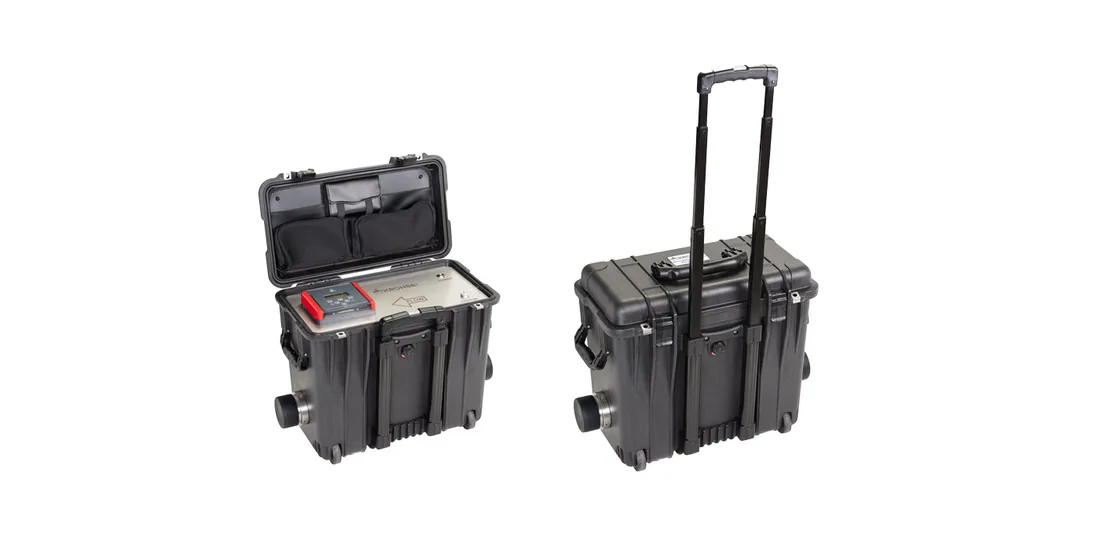
Volume metering case
up to 16 bar · natural gas and biogas, propane, hydrogen and other gases
960840
System components in detail
Volume metering case
Principle
Kármán vortex street · density-independent
Range
2,5–250 m³/h · up to 16 bar
Accuracy
± 1,5 % of reading
Signal / sensors
4–20 mA · PT100 (3-L) · barometric sensor
Connectivity
Wi-Fi hotspot · SCADA (LAN/WLAN) · PDF
Housing
Trolley PP · IP 44 · 560×290×460 mm
Weight
ca. 42,5 kg
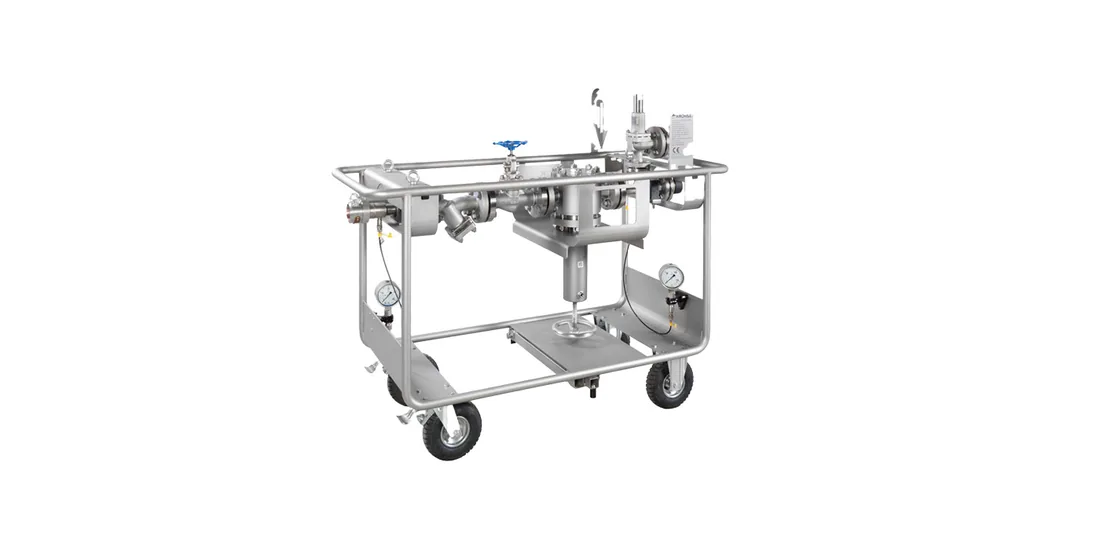
Pressure-reducing stationNEW
Medium
Methane, hydrogen
Inlet pressure
40–100 barg
Outlet pressure
10–25 barg
Flow
methane 1,800 · H₂ 4,800 Nm³/h
Size / Kvs
DN 40 · Kvs 2,5 m³/h
Safety
ATEX fittings · 0.5 mm pre-filter · anti-tip
Build
Stainless · 4 wheels · crane-lift eyes
Performance classes
What your line pressure decides about the choice of unit
The decisive question is not which flare is bigger. It is: what line pressure can you connect to directly — without reducing first?
Maximum connection pressure compared
Small flare for service connections1 bar
Mobile low-pressure flare1 bar
Mobile medium-pressure flare2 bar
Gasfackel DN 255 bar
Gasfackel DN 5016 bar
0481216 bar
DN 50 with pressure reduction station→100 barg
Scale 0 to 16 bar. At 100 barg the pressure reduction station goes far beyond this and is therefore shown open-ended.
Performance class
Maximum pressure
Direct connection up towithout pressure reduction
Small flare for service connections
around 1 bar
around 1 bar
Mobile low-pressure flare
around 1 bar
around 1 bar
Mobile medium-pressure flare
around 2 bar
around 2 bar
Gasfackel DN 25
5 bar
5 bar
Gasfackel DN 50
16 bar
16 bar
Gasfackel DN 50with pressure reduction station
100 barg
16 bar
About these figures:The figures for the market classes summarise publicly available manufacturer data and deliberately name no individual competitors. Throughput values from different manufacturers refer partly to normal cubic metres, partly to operating cubic metres — a direct numerical comparison is therefore only possible to a limited extent. What is unambiguously comparable is the permissible pressure.
What that means on site
You are standing at a line with 4 bar. With a flare rated for 1 or 2 bar you also need pressure reduction: another unit that has to be transported, set up, connected and included in the risk assessment. With the DN 50 you connect directly.
The surcharge for the 16 bar version over the 5 bar version is €175 — on a unit price from €11,119 net that is 1.6 %. Anyone who works on a line above 5 bar even once a year has recovered it.
And if the pressure is higher still?
For transmission lines and pipelines at 40 to 100 barg there is the mobile pressure reduction station: it brings the pressure down to 10 to 25 barg, with ATEX-certified fittings, for methane and hydrogen. The same DN 50 then covers the high-pressure range too, instead of requiring a second flare system.
Not sure what pressure actually reaches the unit in your case? That is exactly what the consultation is for — static pressure and flow pressure are two different things.
Accessories for set-up, connection and safety distance
A flare alone is often not enough for a compliant operation. The volume metering case is listed above as a system component — here is the supplementary accessory range, matched to DN 25 and DN 50.
Diffuser extension DN 50
Raises the flame outlet by 1,800 mm for greater safety distance and visibility. Stainless V2A, with three eyelets for guy ropes. Use only from 1 bar line pressure — at lower pressure the flame burns incompletely inside the tube.
Ground stakes, connection adapters, pressure gauge and transport case are part of the unit — all in stainless steel 1.4301. Not included: degassing hose and the propane cylinder for the pilot flame. We supply the matching hose; for hydrogen we refer you to Mordhorst.
included
03How to get one
Buy, hire or have us flare
Three ways to get rid of your residual gas
You do not necessarily have to buy a unit. Which route suits you depends on how often you flare and whether you have your own trained staff.
Buy
Suitsregular demand, several crews, short-notice availability
Hiring instead of buying a gas flare — when it pays off
For a single construction project, an incident or a trial run before procurement you do not need to buy a unit. Both sizes are available for hire — fully equipped.
Feature
Hire
Purchase
Suits
single project, incident, trial run before procurement
regular network operation, several crews
Minimum period
1 day · dispatch to return
—
Billing
daily, weekly or monthly rate
one-off
Deposit
normally none
—
Credit
creditable against a later purchase by arrangement
—
What you get when hiring
Gasfackel DN 25 — ready for use in the transport case, with VENKRO 25 venturi nozzle
Gasfackel DN 50 — ready for use in the transport case, with VENKRO 50 venturi nozzle and optical flame monitoring
Degassing hoses — on request, matching the size
Volume measuring case — hireable separately if you have to document the flared quantity
Our hire units are consistently fully equipped — you are not renting the stripped-down version.
Delivery and briefing
Delivery by forwarder, delivery by us or collection in Leipzig — your choice. A briefing at the unit is available on site for a surcharge, or online via Teams or Meet. By phone works too, but it is the more awkward route: when flaring, it helps if we are both looking at the same unit.
Incident?If a hire unit is in stock, you can collect it in Leipzig within one hour. Call instead of ordering — on the phone it takes two minutes to establish what is available.
Tell us the period, the application and the line pressure. We will quote daily, weekly and monthly rates on request.
Flaring service
We do the flaring for you — throughout Germany
You do not have to buy a unit, nor hire one. If you need to get rid of residual gas once or twice a year, we come to you with the flare and carry out the operation.
What we have already flared
Natural gas boreholesPipelines ahead of overhaulPropane tanks emptiedHydrogen vessels at filling stations emptiedBiogas plants degassed
How the job runs
The scope follows your needs: setting up and running the flare only, or additionally recording the quantity with the volume measuring case including the log for your documentation. On site you will find the owner himself or a colleague. We operate throughout Germany; at short notice too if unit and staff are available. Billing by arrangement — scope and effort depend on the job.
What you provide
We work with an open flame and corresponding thermal radiation. For the job to work, we need the following from you:
Clear space all around the set-up point — the area depends on local conditions, we clarify that beforehand
An oil-free compressor if the line is to be evacuated with the venturi nozzle (8–16 bar, at least 1.6 m³/min)
A contact person on site
Notification of the fire brigade where required
We bring the propane cylinder for the pilot flame ourselves.
Only you can judge which approvals and permits your site requires — that depends on your plant, your operator and the local authority. We tell you what we need technically; the operational clearance rests with you.
Using the DN 50 gas flare as the example — from setting up to the packed case. The DN 25 works the same way, just one size smaller.
Setting up
1
Choose the locationLevel ground, clear overhead, no vegetation, no ignition sources, two escape routes.
2
Set up the flareOpen the trolley, raise the riser, fold out the three legs until they lock.
3
Earth and secureDrive in the earth spikes with a non-sparking hammer, connect the earthing cable. On asphalt: weighting plates.
4
Fit the upper riserFlat gasket centred, tighten by hand, then a further 30–45° with the hook wrenches.
5
Connect upDegassing hose via 2″ or 2½″ adapter, piezo burner, propane cylinder, pressure gauge.
Flaring
6
Check for leaksPropane side first, then the gas side — with a gas detector or by soaping the joints.
7
Match the unit to the pressureGRS 50 up to 5 bar, GRV 50 up to 16 bar flow pressure. If the pressure does not match, it is reduced.
8
Light the pilot flameRegulator to 1.0 bar, ignite, lock, back to 0.5 bar. Always before the main shut-off valve.
9
Open the gas supplySlowly but fully. Never throttle ball valves. The flame must burn upwards.
10
Flare off and measurePressure drops, flame shrinks. Measure the concentration at the test connection, draw down with the VENKRO 50.
Dismantling
11
Shut downClose the gas line first, then the propane cylinder. Burner valve shut, then open all valves.
12
Take apartPressure gauge, burner, hose, upper riser. Refit the protective caps, secure the flat gasket.
13
Pack awayOnly once fully cooled. Pull the earth spikes, fold the legs, into the trolley.
This overview does not replace the operating manual. What is binding is the unit's operating manual and the rules for working on gas-carrying systems, such as DGUV Information 203-090. The manual comes with every unit; we will send it to you in advance on request. Would you rather hand the job over?We can flare for you.
Knowledge & practice
Guides on gas flaring
Questions that come up on the phone again and again — answered in more depth than a FAQ allows.
What blinds measuring instruments without anyone noticing
Silicone does nothing to the flare. It does plenty to the Ex and methane detectors on the same job — and nobody notices.
Siloxane vapours burn to silicon dioxide on the hot catalyst and settle as a glassy layer on the active surface. The sensor does not die, it goes deaf. That is exactly what makes it dangerous: a failure is noticed, a reading that is too low is not.
Sensor type
What happens
Pellistor — catalytic bead, Ex and CH₄ measurement
The most critical case. SiO₂ coats the active surface, the reading drops too low or to zero. Irreversible — the sensor has to be replaced.
Zirconia O₂ — residual oxygen, 600–700 °C
Same mechanism, because it also works hot. SiO₂ clogs the porous electrode: drift and sluggish response.
Electrochemical cell — O₂, CO, H₂S
Less prone to actual poisoning. But an aerosol film on the sintered filter and diffusion membrane lengthens the response time and damps the reading.
NDIR / infrared
Immune to poisoning. But a silicone film on window and mirror reduces transmission — usually still recoverable by cleaning.
Spray mist from several metres away, or vapours from freshly treated parts in the same room, is enough.
In practice: silicone spray does not belong in the same tool case or the same cab as the instrument. The same goes for silicone-based sealing greases, mould release agents, leak detection sprays and some hand care products. For seals and PE push-fit connections use silicone-free lubricants — soap- or PTFE-based. That is the better choice anyway, because silicone residues later cause wetting defects in coating and problems in welding.
How much residual gas is in the line?
Two figures are enough for the quantity: line volume and pressure. For the duration there is no such formula.
The gas quantity under standard conditions follows from the geometric volume of the section and the absolute pressure:
Standard volume ≈ length × cross-section × absolute pressure
The absolute pressure is the operating pressure plus roughly 1 bar of atmospheric pressure. The cross-section is π/4 × diameter squared.
Section
geometric
standard conditions
Distribution main DN 200, 500 m, 4 bar
15,7 m³
~79 m³
Transmission line DN 500, 5 km, 16 bar
982 m³
~16.700 m³
For the duration this is a rough orientation at best. At 5 bar flow pressure the DN 50 handles around 2,000 m³/h — at 5 bar. As the pressure falls, so does the flow; towards the end hardly anything comes through.
And then the second part only begins: the venturi nozzle works only once the line is depressurised. How long it takes for the reading to drop below half the lower explosive limit depends on the condition of the line — incrustations and deposits keep releasing gas for a long time. Nobody can predict that precisely.
And the calculation applies to the section between the shut-off valves. Which section that is, only the operator knows.
Pump over first, then flare
We sell flares — and still advise against burning gas that can be pumped over.
Gas is a commodity. What stands in the line has been paid for by the operator; letting it burn costs that money a second time. Before an inspection a section is therefore usually pumped over — into an adjacent section, into storage, back into the grid.
That does not empty the line completely. Whatever remains after pumping over still has to come out before anyone opens the line. That is where flaring begins — not with a full line.
And there are cases where pumping over is not possible. Whether that applies is decided by the operator case by case. It cannot be judged from outside.
Flaringreleases the overpressure. As long as there is pressure on the line, the gas flows by itself.
Extractionremoves what no longer comes out on its own once the pressure is gone. The venturi nozzle creates a vacuum; extraction continues until the measured concentration is below half the lower explosive limit.
Without the second stage an ignitable mixture stays in the section. With it, the section can be cut.
When is flaring permitted at all?
Article 15 prohibits routine flaring — and puts rerouting first.
What the equipment has to be capable of is set out in Article 17 — you will find that further up this page. Article 15 governs something else: whether flaring is allowed at all.
“Venting shall be prohibited, except in the circumstances provided for in this Article. Routine flaring shall be prohibited.”Article 15(1)
Both are permitted only in an emergency, during a malfunction — or where they are unavoidable and strictly necessary. The Regulation lists specific situations for this. Two of them bear directly on mobile flaring:
paragraph 3(e)— during repair, maintenance, testing procedures and decommissioning, including blowdown and depressurisation.
paragraph 3(k)— when blowing down or purging a line for the purpose of repair, “but only where the gas cannot be contained or rerouted into an unaffected part of the line”.
The proviso in point (k) is exactly the rule from the topic above — only as legal text. Rerouting comes before flaring.
“In addition to the conditions set out in paragraphs 2 and 3, flaring shall only be allowed where either re-injection, utilisation on-site, storage for later use or dispatch of the methane to a market are not feasible for reasons other than economic considerations.”Article 15(6)
The decisive words in that sentence are “other than economic considerations”: the fact that rerouting would cost more is expressly not accepted as a justification.
And venting instead of flaring?
Conversely, flaring takes precedence over venting. Under paragraph 4, venting is only allowed where flaring is not technically feasible — because the flame cannot be ignited or sustained, because it would endanger safety, or because it would have worse environmental effects in terms of emissions. That justification has to be evidenced to the competent authority.
Reporting duties under Article 16
Events caused by an emergency or malfunction: report without delay, at the latest within 48 hours of their start.
Events lasting eight hours or more in total within 24 hours: likewise.
Controlled flaring during a shutdown: in the annual report.
Annex III lists the information to be provided. For the quantity you need a measurement — that is what the volume measuring case is for.
Who this applies to
The Regulation applies to the energy sector: production and processing of oil and fossil gas, wells, transmission and distribution of natural gas, underground storage, LNG facilities and coal mines (Article 1(2)). Biogas plants and industrial end users do not fall under it — different rules apply there.
This information reproduces the text of the Regulation and does not constitute legal advice.
What has to be settled before the job
Most delays on site have nothing to do with the equipment.
Details of the section
Operating pressure and medium
Volume, or length and diameter
which shut-off valves bound the section
Without these details neither the size nor the safety device can be determined.
Requirements for the site
level and firm, completely clear overhead
clear working space all round — we work with an open flame and the heat radiation that comes with it
no vegetation, no ignition sources, two escape routes
To be provided by you
Personal protective equipment, warning signs, gas detector
when the venturi nozzle is used, a site compressor for oil-free compressed air, at least 8 bar and 1.6 m³/min
We bring the propane cylinder ourselves when we carry out the job.
What only you can decide
Whether the fire brigade has to be informed, whether permits are required, how the risk assessment turns out — that depends on your local conditions and internal rules. DGUV Information 203-090 is the guidance document for this. We can advise, but we cannot decide it for you.
Gas flares, flaring & the EU Methane Regulation — briefly explained
What is a gas flare or flaring unit?
A gas flare (flaring unit) burns residual gas from pipelines or tanks in a controlled way outside the working area. This avoids methane emissions before a line is worked on or newly commissioned.
DN 25 or DN 50 — which gas flare do I need?
The DN 25 flares around 700 m³/h at 5 bar flow pressure and suits distribution networks and house connections. The DN 50 handles around 2,000 m³/h; we supply it as standard in the 16 bar version — so far we have sold that version exclusively. It is the choice for transmission and high-pressure lines as well as pipeline construction. For mixed duties the DN 50 also covers the DN 25 range. Anyone working on lines above 5 bar saves the upstream pressure reduction and its set-up with the 16 bar version.
Which gas types can be flared?
Natural gas, biogas, propane, town gas and hydrogen (H₂-ready). Both sizes are multi-gas capable. With hydrogen the optical flame monitoring is particularly important because the H₂ flame is barely visible to the naked eye — irrespective of the gas type, Article 17(4) of the EU Methane Regulation requires a flame monitor anyway when a continuous pilot burner is used. In January 2025 DBI tested the DN 25 with pure hydrogen and certified complete burnout up to 0.4 bar and 360 m³/h.
What does the EU Methane Regulation 2024/1787 require for flaring?
Two things. First, the unit itself must meet Article 17: at least 99 % destruction and removal efficiency plus an auto-igniter or continuous pilot burner. The deadline for all units expired on 5 February 2026. Second, Article 15 restricts flaring as such: routine flaring is prohibited, while it remains expressly permitted for repair, maintenance and decommissioning as well as for purging during commissioning. Flared quantities must be reported under Article 16.
Which regulations apply to mobile flaring in the gas network?
The relevant framework is EU Methane Regulation 2024/1787 with three applicable articles: Article 15 restricts flaring as such, Article 16 governs the reporting duty, Article 17 sets the requirements for the unit. In addition there are the DVGW codes G 404 (technical reduction of methane and hydrogen emissions) and G 424 (guideline on reducing methane emissions) as well as TA Luft. Our gas flares are tested by DBI Freiberg to the EU Methane Regulation, VDI 2105 (10/22) and TA-Luft (08/2021); quantity recording is handled by the volume measuring case.
How is the flared gas volume documented?
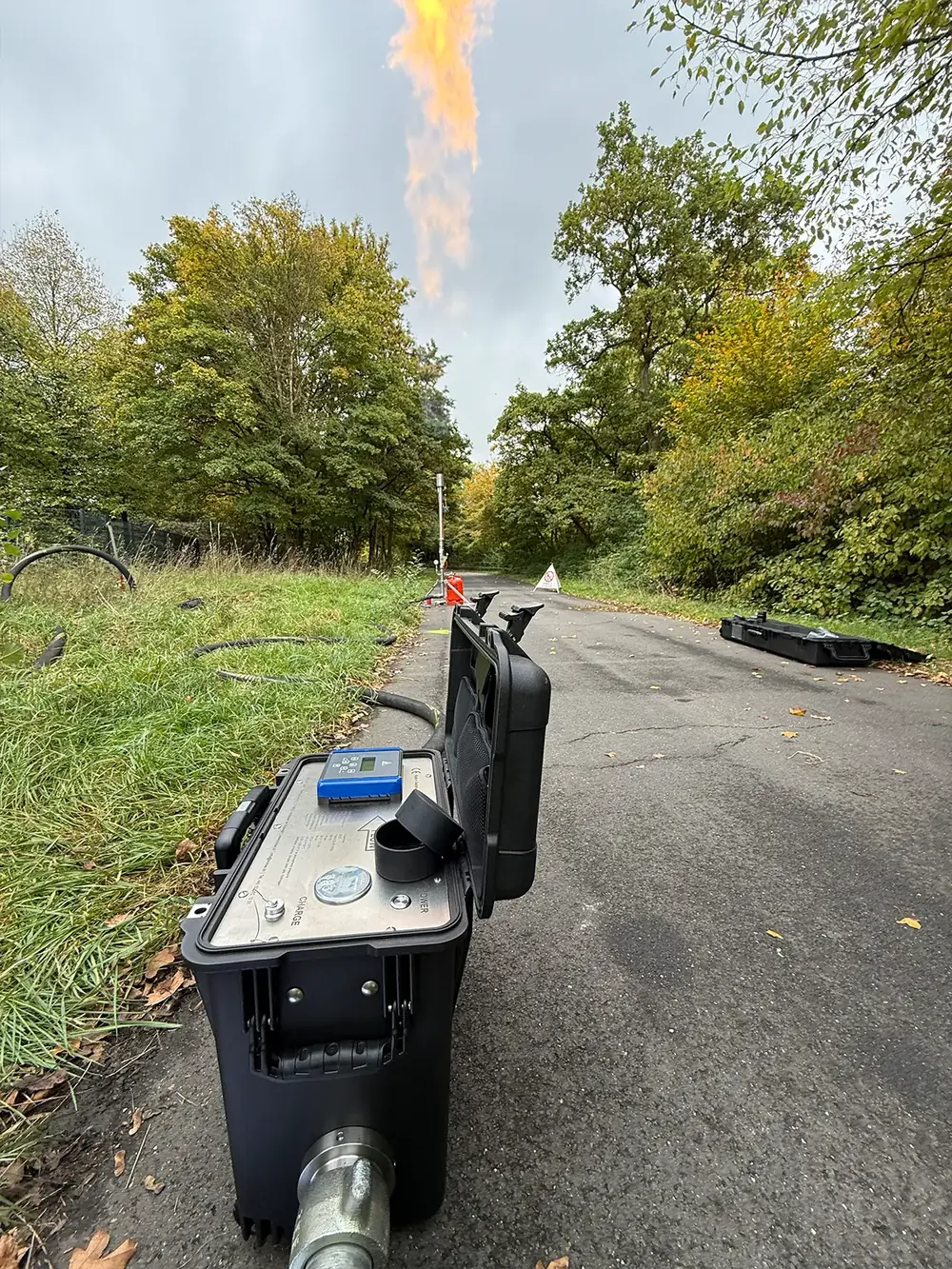
The volume metering case measures density-independently using the Kármán principle in the range 2.5–250 m³/h up to 16 bar with ± 1.5 % accuracy and automatically generates PDF logs — available via Wi-Fi or SCADA.
Are the gas flares certified?
Yes. DBI — Gastechnologisches Institut gGmbH Freiberg tested both sizes to EU Methane Regulation 2024/1787, VDI 2105 (10/22) and TA-Luft (08/2021) (report no. 81-8108-2024). Both carry the DBI test mark. The GRS25 and GRV50 safety fittings (IBEDA) are DVGW-certified. EN 1762:2018 · CE and ISO 3821 (EN 559) apply to the connecting hoses, not to the unit itself.
Do you offer maintenance, service and spare parts?
Yes — maintenance, service and spare parts come directly from us. In our workshop in Leipzig (Plautstraße 80, 04179 Leipzig) we test, service and repair the units ourselves, without a detour via the manufacturer, and keep common spare parts in stock. This includes the annual inspection of the IBEDA safety fittings for tightness and safety against gas return required by the manufacturer's data — for the GRV50 in accordance with TRBS 1201, Table 2. We are an official sales and service partner of KROHSE GmbH for Germany — having the annual service done by us keeps warranty and liability in force.
How quickly is the gas flare ready for use?
In about two minutes. The necessary tools are included in the transport case — ideal for changing sites.
What does a mobile gas flare cost?
The DN 25 gas flare starts at €5,499 net, the DN 50 at €11,294 net — depending on the version. The volume measuring case for quantity documentation costs €10,990 net. All prices are net, plus 19 % VAT. Binding prices for all versions are in our shop.
Can I also hire a gas flare?
Yes, both sizes. The minimum hire period is one day. It runs from dispatch until the day the unit arrives back with us — so the shipping time in both directions counts. Billing is at a daily, weekly or monthly rate. We normally do not require a deposit, and by arrangement we credit the hire cost against a later purchase. The hire units are fully equipped: the DN 25 with the VENKRO 25 venturi nozzle, the DN 50 with the VENKRO 50 and additionally optical flame monitoring.
How long is the delivery time?
That depends on the version and the quantity. We configure every unit to your application — version, pressure rating, venturi nozzle, flame monitoring and matching hose. As a rule that goes quickly, but our stock is not unlimited: larger quantities or special configurations take longer. We give you a binding date with the quotation. Hire units are available at short notice provided they are not out on another job — in that case call us rather than ordering.
Can you also carry out the flaring for us?
Yes, throughout Germany. We come to you with the flare and carry out the flaring operation — including quantity recording and a log on request. On site you will find the owner himself or a colleague. Among other things we have flared natural gas boreholes, pipelines ahead of overhaul, propane tanks, hydrogen vessels at filling stations and biogas plants.
Do I need flame monitoring?
Article 17(4) of the EU Methane Regulation requires: where auto-igniters or continuous pilot burners are used, operators must employ flame monitors for continuous monitoring of the main or pilot flame. Our units work with a continuous pilot burner. The optical flame monitoring performs this task and is included in the PREMIUM PRO PLUS (DN 25) and PREMIUM-PRO+ (DN 50) versions. We recommend it — particularly for hydrogen, whose flame is barely visible. Whether it is required for your application is for you or your consulting engineer to assess.
What safety distance must I maintain?
We deliberately do not specify one — the risk assessment is the operator's responsibility and we do not know your site. Two points to plan for: at low pressures wind plays a major role and the flame drifts sideways. At high pressures considerable thermal radiation develops upwards and to the side. The DN 50 diffuser extension raises the flame outlet by 1,800 mm and noticeably reduces radiant heat at ground level. Describe your situation to us — we will tell you what we watched out for in comparable cases.
What compressed air do I need for the venturi nozzle?
An oil-free site compressor with 8–16 bar and at least 1.6 m³/min. Any oil carry-over must be avoided. A vent must be opened at the opposite end of the line. If the primary flame goes out in the process: close the compressed air, measure the gas concentration — only shut down below 50 % LEL.
Why don't you state explosion groups?
Because they are not the appropriate designation for our design. The IBEDA GRS and GRV safety fittings are built to DIN EN ISO 5175-2. That standard classifies by gas type and working pressure — which is why you find figures such as “up to 5 bar methane” rather than “IIA/IIB/IIC”. Explosion groups come from the standards for components with an integrated flame arrester. We are happy to clarify with you which design suits your application.
What is included in the scope of delivery — and what is not?
Included are ground stakes, connection adapters, a pressure gauge and the transport case — all in stainless steel 1.4301. Not included are the degassing hose and the propane cylinder for the pilot flame. We supply the matching hose; for hydrogen we do not carry hoses and refer you to Mordhorst. All units are supplied exclusively with a transport case — that way every part has its place on the way to the site.
Do the safety fittings have to be tested regularly?
Yes. The IBEDA data sheets require the safety devices to be tested at least once a year by a trained and authorised person for gas tightness and safety against gas return — for the GRV50 expressly in accordance with TRBS 1201, Table 2. The fittings must not be opened; the dust filter may be cleaned or replaced. We carry out this inspection in our workshop in Leipzig.
How do I get a quote for a gas flare?
Via the contact form or by phone on +49 176 10216596. Four details help: application, estimated residual gas quantity, line pressure and gas type — you can select them directly in the form. We recommend the right unit including measuring equipment and accessories, and usually reply within one working day.
05Who is behind it
Why AB Industrie
Advice, servicing and spare parts from Leipzig
Many supply a flare. We supply the complete, verifiable flaring process — coordinated equipment from a single source, backed by service and spare parts.
Complete solution from one source
Flare, volume metering case, pressure reduction station and accessories — coordinated with each other instead of individual parts from different suppliers. One contact for the whole process.
Empty down to the ppm range
The Venturi nozzle actively draws the residual gas out of the line — well below 50 % LEL, down to the ppm range. Separate nitrogen purging can therefore be omitted.
Rent or buy
Rent for a single project or buy permanently — you decide flexibly depending on how often you use it. Including briefing and delivery on request.
High pressure & high throughput
Up to 16 bar inlet pressure and around 2,000 m³/h (DN 50) — with the pressure reduction station even pipeline pressures up to 100 bar. Significantly more than common low-pressure flares.
Service & spare parts on site
Maintenance, repair and common spare parts directly from our workshop in Leipzig — without a detour via the manufacturer, quickly reachable and with briefing on request.
Verifiable EU documentation
The volume metering case automatically logs flow rate and volume as a PDF — audit-proof for authorities, QA and audits under the EU Methane Regulation 2024/1787.
Annual inspection and servicing — in Leipzig, not on site
The IBEDA safety fittings must be tested at least once a year for tightness and safety against gas return — for the GRV50 in accordance with TRBS 1201, Table 2. This cannot be done on site: the unit is completely dismantled for it. Test and inspection equipment as well as the special jig for dismantling and assembly are located exclusively in our workshop in Plautstraße. We have already serviced and tested dozens of units there.
What happens during servicing
The unit and transport case are cleaned, the burner mount checked for damage
The safety fitting is released, the basket filter removed, threads and fitting cleaned
Testing of the IBEDA fitting for gas non-return function in accordance with TRBS 1201
A new basket filter (stainless steel 1.4305, 100 µm) and new seals are fitted
Folding feet checked at 10 Nm, ball of the main shut-off valve and pressure gauge coupling lubricated
O-rings on degassing hoses and adapters are replaced, all threaded connections checked
Pressure gauges checked for accuracy — permissible deviation no more than 100 mbar from full scale
Piezo burner, propane hose and pressure regulator checked, degassing hoses for cracks, porosity and kinks
Finally a service label is applied to the unit
Tightness test with nitrogen
Test step
DN 25
DN 50
up to the main shut-off valve
8 bar
24 bar
complete unit
6 bar
17 bar
The test is documented. You receive the inspection report with the service — for your files, quality management and evidence towards the authorities.
And before every use?Article 17(3) of the EU Methane Regulation requires an inspection before every use for irregularly used flares. We brief your team on what to look out for.
What you do yourself — maintenance level L1
The manufacturer distinguishes two levels. L1 you do yourself, right after the job. L2 is the annual service described above — the unit is completely dismantled for it.
After every job: let the unit cool down and clean it with Ballistol — no aggressive agents, they attack the corrosion protection and the seals
After every job: check the O-rings of the degassing hoses
After every job: check the piezo burner set for cracks in the hose and impact damage to burner and pressure regulator
After every job with the venturi nozzle: check seal, shut-off fittings and hose at the compressed-air connection, grease the safety claw coupling with Ballistol
Every third job: check the pressure gauge and its coupling for clean, undamaged connections and grease them
Every third job or sooner: take out the pre-filter screen, clean it with brake cleaner and blow it out — or replace it
After a job in wet conditions: dry everything and store it in a ventilated room
Degassing hose and propane hose have a service life of eight years. Temperature, UV light, contact with media and heavy mechanical stress shorten it — which is why the visual check belongs in the L1 routine.
Silicone does not harm the flare — it harms the instruments:The unit itself does not care about silicone. What is at risk are the Ex and methane detectors running on the same job: siloxane vapours burn to silicon dioxide on the pellistor and settle as a glassy layer on the active surface. The sensor does not die, it just goes deaf — the instrument keeps running and reads low or nothing at all. Spray mist from several metres away is enough. So silicone spray does not belong in the same tool case or the same cab as the instrument.More on this in the guide
Important for your warranty:The annual service is classified by the manufacturer as level L2 and may only be carried out by KROHSE GmbH or one of its service partners — otherwise warranty and liability claims lapse immediately. We are an official sales and service partner of KROHSE GmbH for Germany; with us both remain in force.KROHSE partner list
Frank Abraham founded AB Industrie Service in Leipzig in 2010 — after years of advising pipeline crews on site, in the trench, tool in hand. Nothing enters our range that we would not work with ourselves. For flaring equipment that is KROHSE: we are the official sales and service partner for Germany, advise before the sale, supply the right device with its accessories and service it later in our own workshop.
2010Founded in Leipzig
D · A · CHMain markets — delivery throughout the EU
Own workshopServicing, testing and repair in house
Our own jobs — carried out with our units, partly on assignment, partly as a service.
Where else residual gas occurs
Wherever gas is carried or stored, sooner or later the question arises: where does it go? During an overhaul, a repair, a conversion or a decommissioning. This list describes possible applications — not jobs we have carried out.
Distribution network and service connectionsDecommissioning and removal of connections and distribution lines · refurbishment and relocation · the L-to-H gas conversion running until 2030 · purging when commissioning new network sections
Transmission, storage, compressionTransmission lines before pigging, overhaul or conversion · gas pressure regulating and metering stations · underground and cavern storage · compressor stations
Production and boreholesNatural gas boreholes and production tests · wells being decommissioned or plugged — Article 18 of the EU Methane Regulation obliges member states to inventory them
Biogas, sewage gas, landfill gasBiogas plants during maintenance on digesters or gas holders · sewage works when the CHP unit, boiler or the fixed emergency flare fails or is being serviced · landfills with gas collection
LPGPropane tanks before emptying, decommissioning or relocation · cylinder stores · tankers before repair
HydrogenHydrogen filling stations · electrolysers, test rigs and pilot plants · conversion and blending projects in the network
Industry and plant engineeringRefineries and chemical parks during plant overhauls · industrial thermal process plants · CHP units and heating stations · gas-fired production plants before conversion
Dismantling and decommissioningCNG filling stations, many of which are currently being closed · complete plants before demolition · network sections being taken off the grid permanently
Your case not listed? It probably still fits. Tell us the residual gas quantity, line pressure and gas type — we will tell you whether it works and with which size.
06Let's talk
Personal advice
Three steps to the right unit
Small enough to listen. Large enough to deliver. No wading through catalogues, no guesswork: you describe the application, residual gas quantity, pressure and gas type — we recommend the right flaring unit including measuring equipment and deliver it. Across Europe.
1
EnquireApplication, residual gas volume, pressure and gas type — briefly, by form or email.
2
Recommendation & quoteWe recommend the right unit with metering technology and accessories — specific, with pricing.
3
DeliveredAcross Europe, with on-site instruction on request.